National Mosque of Malaysia, Mosque in Kuala Lumpur, Malaysia
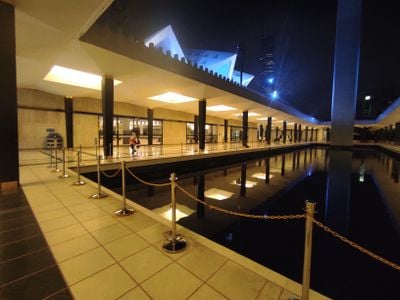
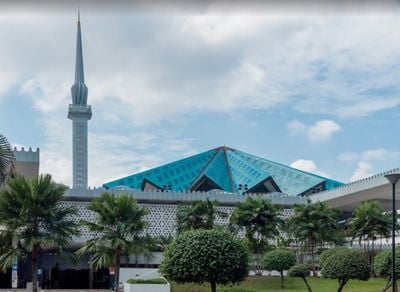
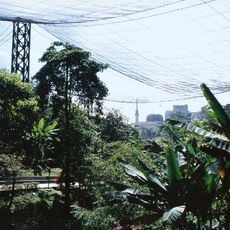
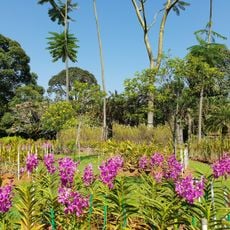
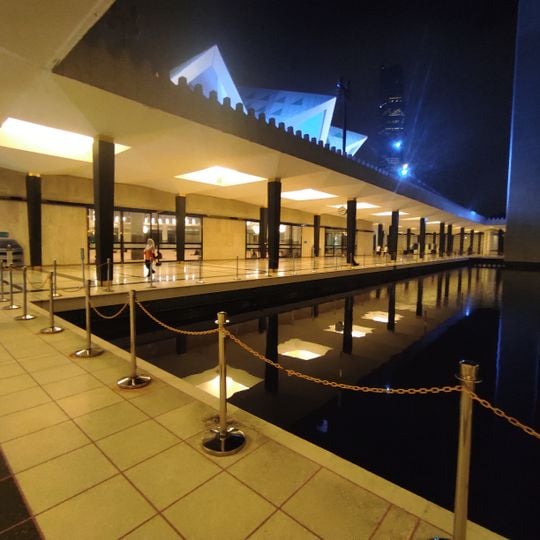
The site is a modern Islamic building in Kuala Lumpur with a tall minaret and a star-shaped concrete roof. The grounds include water features around the prayer hall and lawns with palms that provide shade.
The mosque was proposed in 1957 as a symbol of independence and named Masjid Negara by Prime Minister Tunku Abdul Rahman, who declined to have it named after himself. Its foundation stone was laid on 27 February 1963 on a site acquired in 1961, and the third Yang di-Pertuan Agong, Tuanku Syed Putra of Perlis, opened it on 27 August 1965. Renovations in 1987 replaced the original pink concrete roof with green and blue tiles.
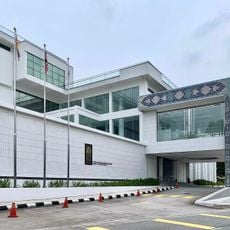
The mosque's name, Masjid Negara, was chosen by Tunku Abdul Rahman as a thanksgiving for independence gained without bloodshed, after he declined to have it named after himself. Its construction was funded by the federal government together with donations from Muslims, Christians, Buddhists and Hindus, and it was designed by a Malay architect and built by Chinese and Indian workers. The Syeikh Mohamad Idris Al-Marbawi library and the Islamic Outreach ABIM counter serve visitors today.
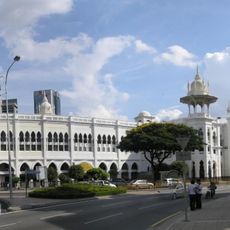
The complex sits beside Jalan Sultan Hishamuddin, a short walk from the Kuala Lumpur railway station and linked to Pasar Seni LRT and MRT stations; the free Go KL City Bus Red Line stops at Masjid Negara. The grounds cover 13 acres with seven entrances to the main building, and the minaret has a lift to a platform 140 feet up. Visitors enter through a separate route to the outer courtyards and galleries.
The entire design adopts the form of umbrellas, with the main roof resembling an open umbrella and the top of the minaret a folded one. This visual language repeats in smaller structures and canopies throughout the complex.
The community of curious travelers
AroundUs brings together thousands of curated places, local tips, and hidden gems, enriched daily by 92,584 contributors worldwide.