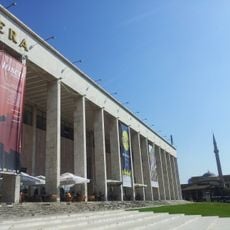
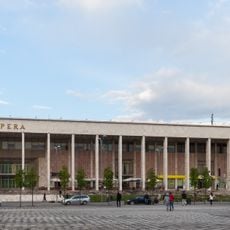
National Historical Museum, Museum complex at Skanderbeg Square, Tirana, Albania.
The National Historical Museum is a large complex at Skanderbeg Square with several separate pavilions documenting different periods of Albanian history. The collection spans from the Late Paleolithic era to modern times, featuring significant objects and documents from medieval Albanian kingdoms.
The National History Museum opened on 28 October 1981, becoming Albania's largest museum institution, with 27,000 m² of building and 18,000 m² of exhibition space. Its eight pavilions were arranged to present about 4,750 objects from the 4th millennium BC to the second half of the 20th century. The museum is closed for renovation until 2028.
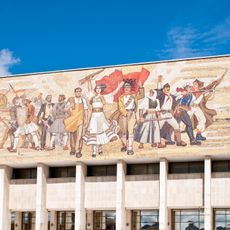
Above the entrance is the mosaic The Albanians, made in 1980 by five painters including Vilson Kilica and Anastas Kostandini, in Socialist realism style. It is about 11 m high and 40 m long, covers 440 m² and shows 13 figures, from an Illyrian warrior to five partisans. In the early 1990s the golden stars above the central woman and the flag were removed, and the worker's red book became an empty sack.
The museum is closed for renovation until 2028, so check before planning a visit. When it reopens, the entrance with The Albanians mosaic faces Skanderbeg Square, and the eight pavilions run from Antiquity to the Communist Terror and Mother Teresa sections.
The mosaic above the entrance, The Albanians, was altered in the early 1990s: a golden star over the central woman's head and a smaller one above the flag's twin eagle heads were removed, and the red book carried by the communist worker was replaced with an empty sack.
The community of curious travelers
AroundUs brings together thousands of curated places, local tips, and hidden gems, enriched daily by 93,418 contributors worldwide.