Saint Gevorg Monastery of Mughni, Religious monastery in Mughni, Armenia
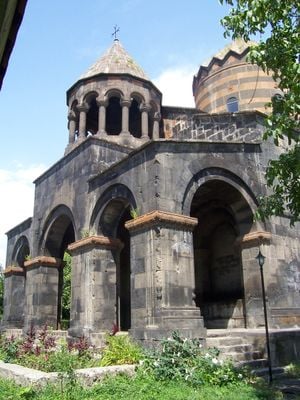
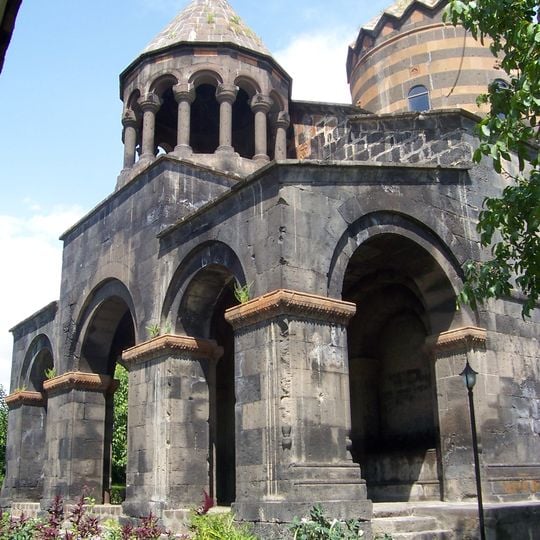
Saint Gevorg Monastery is a domed basilica of black and reddish tuff, its west side fronted by a triple-arched open hall. Above the central bay rises a twelve-column rotunda belfry, while the main dome sits on a cylindrical drum with a conical umbrella roof. A taller striped drum with a round window stands to the right, and the south portal has a richly carved frame.
A 6th-century chapel on the site held the remains of Saint George before the monastery was founded, probably in the first half of the 13th century, when the monks of Hovhannavank brought his relics here; manuscripts were copied at Mughni by 1278. Bishop Martiros rebuilt the complex between 1632 and 1655, and in 1664-1669 Hovhannes vardapet replaced it with the present tuff church, finished by Davit vardapet after Hovhannes died at Agulis in 1669.
Pilgrims come for the feast day held on the last Saturday of September, when the monastery becomes a place of veneration. A curtain donated in 1811 by the merchant Hovhannes and his wife Tamar, embroidered with the Crucifixion and Saint George spearing the dragon, is now kept in the History Museum of Armenia. In the 19th century the monastery also drew Georgian and Persian pilgrims.
The monastery stands along the main road through Mughni village near Ashtarak, making it easy to access. Its location makes it a convenient stop for visitors exploring Armenian religious history.
Inside the monastery stands a marble tomb featuring a green semicircular stone from Jerusalem, polished smooth by countless touches from visiting pilgrims. This artifact shows the long history of devotion at this location.
The community of curious travelers
AroundUs brings together thousands of curated places, local tips, and hidden gems, enriched daily by 92,782 contributors worldwide.