Hovhannavank, Medieval monastery in Ohanavan, Armenia
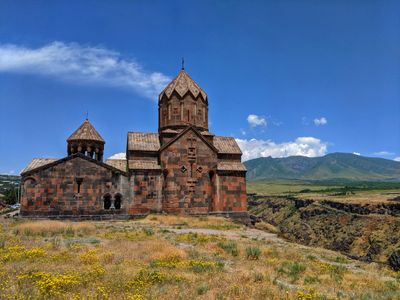
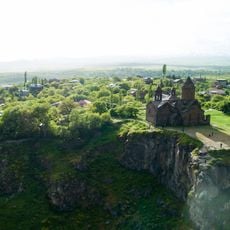
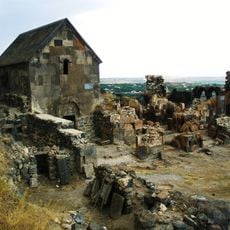
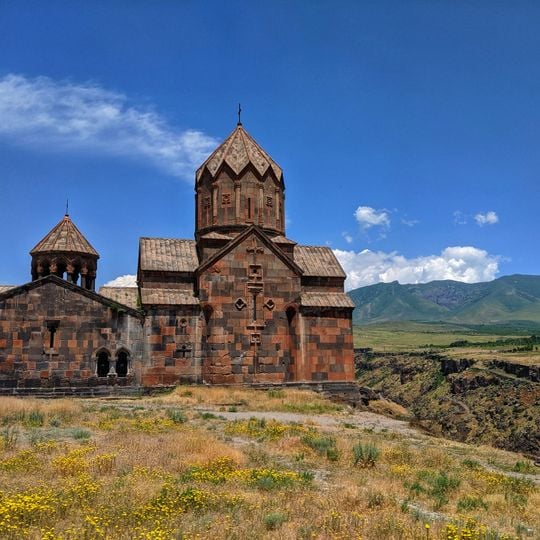
Hovhannavank is a monastery complex positioned on the western edge of the Kasagh Gorge, bringing together buildings from different periods in one cohesive site. The compound includes a main cathedral, a basilica church, a gavit, and defensive walls that enclose and protect the structures.
The oldest structure is the single-nave basilica of St. Karapet, founded at the start of the 4th century by St. Gregory the Enlightener; its wooden roof was replaced in 554. The Cathedral was built between 1216 and 1221 for Prince Vache I Vachutian, and his son Kurt added the narthex in 1250, with its rotunda on twelve columns added in 1274. A 1918 earthquake destroyed the dome and south wall, rebuilt in the 1990s.
The name Hovhannavank comes from Hovhann, a monastery leader appointed by Ghazar Parpetsi, though locals long called it Hannavank. The 13th-century cathedral carries carved scenes of the Parable of the Wise and Foolish Virgins from Matthew 25. Inscriptions on the walls, in Armenian and dated between the 13th and 18th centuries, record construction, repairs and donations.
The complex is accessible via road networks connecting to the nearby city of Ashtarak, making it relatively easy to reach. Wear sturdy footwear, as the terrain is uneven and pathways between buildings involve uphill sections and varied ground surfaces.
The cathedral's dome has an umbrella-shaped roof, a form found in Armenian churches of the Gandzasar type. On the walls, inscriptions record donations: one from 1200 names the brothers Zakaria and Ivane, sons of Sargis, during the reign of Queen Tamar.
The community of curious travelers
AroundUs brings together thousands of curated places, local tips, and hidden gems, enriched daily by 92,789 contributors worldwide.