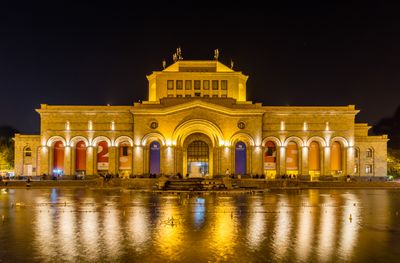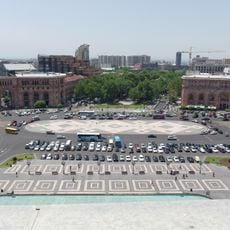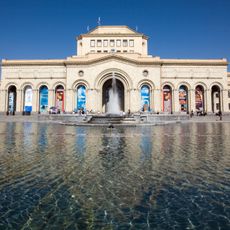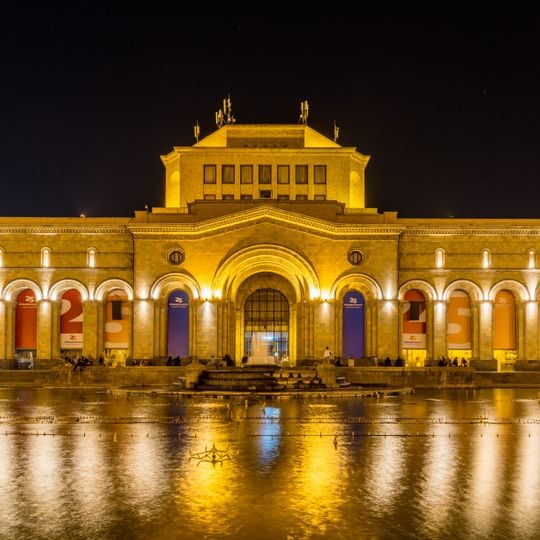
National Gallery of Armenia, Art museum on Republic Square, Yerevan, Armenia
The National Gallery of Armenia occupies floors three to eight of the Museum Complex on Republic Square in Yerevan; the two lower floors hold the National History Museum. Its 56 halls display around 42,000 works, about 700 of them Armenian art, from Urartu frescoes and medieval miniatures to canvases by Aivazovsky, Sureniants and Saryan. The Western section of roughly 170 pieces is built on Italian, Flemish, Dutch and French collections.
Founded in 1921 by decree of the Armenian SSR as the art section of the State Museum, it opened with works bought at an Armenian painters' exhibition in August 1921. The transfer of the Armenian Cultural Center collection (the former Lazarian Seminary, Moscow) and artists' donations brought 400 works into six halls by 1925. It became a separate Art Museum in 1935, was renamed the State Picture Gallery of Armenia in 1947, and took its present name in 1991.
The gallery's Armenian holdings include over 62 canvases by Ivan Aivazovsky, a Russian painter of Armenian descent, and a large group of works by Hakob Hovnatanyan, founder of the Armenian portrait genre. In 2008 a pavilion opened for Hakob Gyurjian's works. The collection also holds silver book-covers, crosses and 18th-century altar curtains from Armenian Apostolic churches across Asia.
The museum sits in the city center and is easy to reach on foot, especially if you are exploring the area around Republic Square. Plan to spend an hour or two if you want to look at the works without rushing.
The gallery holds around 200,000 archive items — photographs, notebooks, letters and personal belongings of Armenian and international artists — and preserves fragments of medieval church frescoes from Aruch, Tatev, Haghpat, Ani and Akhtala. A pavilion for Hakob Gyurjian's works opened in 2008.
The community of curious travelers
AroundUs brings together thousands of curated places, local tips, and hidden gems, enriched daily by 92,634 contributors worldwide.