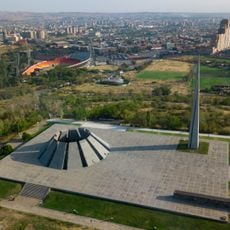
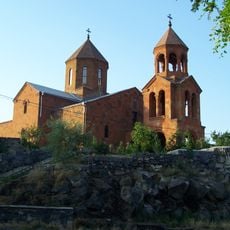
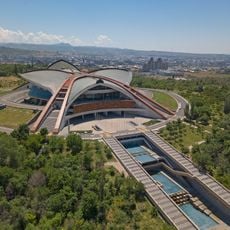
Dalma garden, Historic garden in Yerevan, Armenia
Dalma Gardens is a largely ruined historic fruit-growing area of about 530 hectares between Yerevan's Kentron, Ajapnyak and Malatia-Sebastia districts, once the city's largest and oldest orchard. It lies on a south-west facing slope, and the Dalma canal built under King Rusa II still runs through it, surfacing near the Hrazdan bridge after about three kilometres underground.
The gardens were created under King Rusa II of Urartu, whose cuneiform inscription near Zvartnots church first mentions them and the Uméshe canal. In 1815 Husein Quli Khan had the silted canal cleared and 149 gardens planted on the Hrazdan's right bank. Soviet authorities transferred the gardens to a kolkhoz in 1931.
The name Dalma, also recorded as deolme, is explained by Movses Khorenatsi and Yervand Shahaziz as a Persian word for reopening a blocked channel or clearing what is filled. The garden's irrigation channel, called Umeshe in Rusа II's cuneiform inscription, still runs underground for about three kilometres near the Hrazdan bridge.
The garden stretches from the Tsitsernakaberd hill toward the Zvartnots temple area, and the Dalma canal still runs through it: it starts near the Davtashen bridge, passes about three kilometres underground and surfaces near the Hrazdan bridge. The canal was 8.5 km long and carried the largest volume of water of Yerevan's channels.
In 1950, excavations at Karmir Blur uncovered seven wine cellars holding 420 karases, each with a capacity of 800 to 1,200 litres. Grape seeds inside matched varieties still grown in Dalma today, including yezandari, kharji, askyari and mskhali. A carbonised grape found there was studied in 1962 by winemaker Derenik Safaryan at the request of academician Boris Piotrovsky.
The community of curious travelers
AroundUs brings together thousands of curated places, local tips, and hidden gems, enriched daily by 92,610 contributors worldwide.