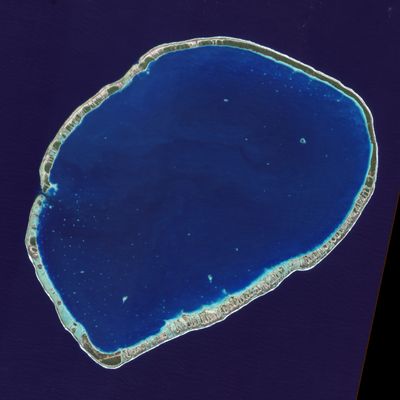
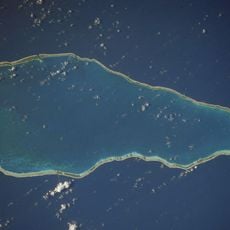
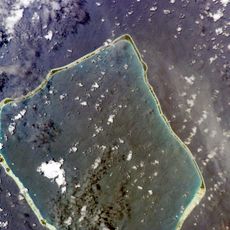
Tikehau, Coral atoll in the Tuamotu Archipelago, French Polynesia
Tikehau is an oval atoll in the Palliser Islands, 340 km northeast of Tahiti, made up of two main islands and numerous islets on an almost continuous reef. Its lagoon measures 27 km by 19 km and covers about 461 km². Tuheiava Pass, on the western shore, is the only navigable entrance. The main village, Tuherahera, sits in the south.
The first recorded European arrival was the Russian mariner Otto von Kotzebue, who reached the atoll on 25 April 1816 and named it Krusenstern Island after the explorer Adam Johann von Krusenstern. The Wilkes Expedition passed by on 8 September 1839. In 1987 Jacques Cousteau's research group studied the lagoon.
Tikehau means "Peaceful Landing" in Tuamotuan, and the atoll is also called Porutu-kai. Most of the 560 residents live in the village of Tuherahera in the south, where the Catholic church of Saint-Nicodème stands; its history dates to 1867, though the present building was consecrated in 1992.
Tikehau lies 340 km northeast of Tahiti, with Rangiroa 12 km to the east. Its 1,200 m airfield, opened in 1977, receives daily flights from Tahiti. Tuheiava Pass on the western shore is the only navigable entrance to the lagoon; the main village, Tuherahera, sits in the south.
In 1987 Jacques Cousteau's research group studied the lagoon and found more fish species there than anywhere else in French Polynesia. The atoll is also an elevated one: its highest point stands 10 metres above sea level, the coral rim lifted by a lithosphere bulge 1 to 2 million years ago.
The community of curious travelers
AroundUs brings together thousands of curated places, local tips, and hidden gems, enriched daily by 92,676 contributors worldwide.