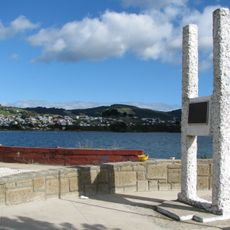
Fuerte San Antonio, Spanish colonial fort in Ancud, Chile.
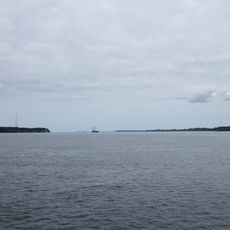
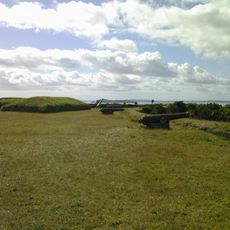
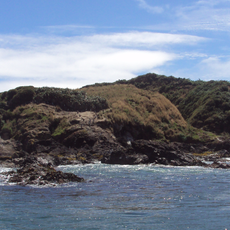
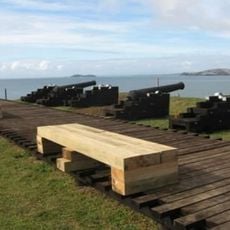
Fuerte San Antonio is a Spanish colonial fort built in the 18th century on a hill at the edge of Ancud, Chile, with a clear view over the bay. Seven original cannons and sections of defensive walls are still in place, giving a clear sense of how the structure was laid out.
The battery began as the Batería de Tecque, built between 1770 and 1780 on the Punta de Tecque with room for four cannons, as part of the coastal defenses begun after Chiloé passed to the Viceroyalty of Peru in 1768. In 1820 Governor Antonio de Quintanilla reinforced it, increased its firepower and renamed it San Antonio. It helped defend Ancud during the independence war until the city surrendered in January 1826.
The obelisk on the grounds was installed in 1926, on the centenary of Chiloé's annexation to Chile. It bears representations of José Santiago Aldunate, the first Chilean governor, and Antonio de Quintanilla, the last Spanish governor of the archipelago.
The fort is about a half mile (roughly 800 meters) from Ancud's main square and can be reached on foot along Baquedano Street. Access is open, and the site is compact enough to visit in a short stop during a walk through the city.
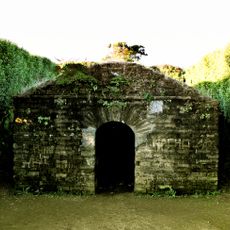
An underground tunnel once linked this fort to the powder magazine at Fuerte San Carlos before being sealed following the 1960 earthquake. The passage is no longer accessible, but its existence shows that the two forts were designed to work as a connected system.
The community of curious travelers
AroundUs brings together thousands of curated places, local tips, and hidden gems, enriched daily by 94,035 contributors worldwide.