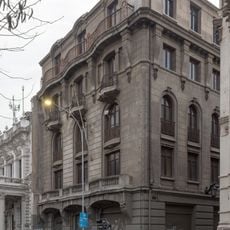
Palacio arzobispal de Santiago, Archbishop's Palace near Plaza de Armas, Chile
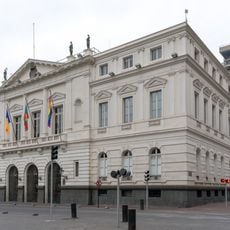
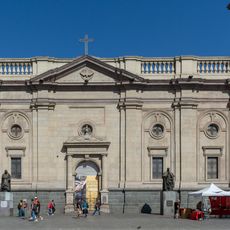
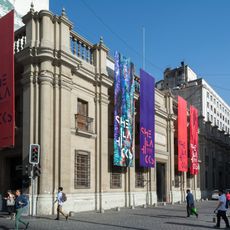
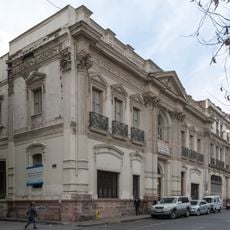
The Palacio Arzobispal de Santiago is a three-story neoclassical building with a rectangular inner courtyard whose facade facing Plaza de Armas displays Doric and Corinthian columns. The ground floor contains retail spaces, while the upper levels house religious administrative offices and ceremonial rooms.
Construction began in 1852, commissioned by the government of President Manuel Montt and designed by the French architect Claudio Brunet de Baines. After Brunet died in 1855, work stopped until 1869, when the French architect Lucien Hénault resumed it; the building was finished in 1870. On 17 January 1975 it was declared a Monumento Histórico by decree, and from 1 January 1976 the Vicaría de la Solidaridad, the human rights body founded by Cardinal Raúl Silva Henríquez, had its national headquarters here.
It serves as the administrative center for the Archdiocese of Santiago de Chile and houses religious artworks, paintings, and stained glass windows. These collections tell the story of the Catholic Church in the region.
The palace is located on Ahumada Street at number 444 near Plaza de Armas, where it is easily accessible on foot and its facade is visible from the street. Since the lower levels contain retail shops, visitors can explore the exterior and sometimes access parts of the inner courtyard.
From its founding on 1 January 1976, the Vicaría de la Solidaridad, the human rights body created by Cardinal Raúl Silva Henríquez, had its national headquarters in the archbishop's palace. The building was declared a Historical Monument on 17 January 1975, during Pinochet's military dictatorship.
The community of curious travelers
AroundUs brings together thousands of curated places, local tips, and hidden gems, enriched daily by 92,822 contributors worldwide.