Bicentennial Bridge, Transportation bridge in Córdoba, Argentina
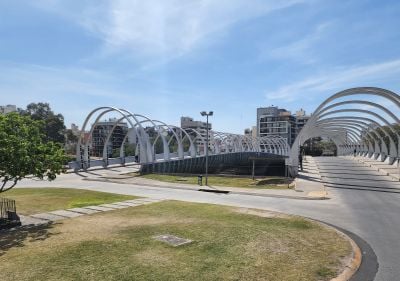
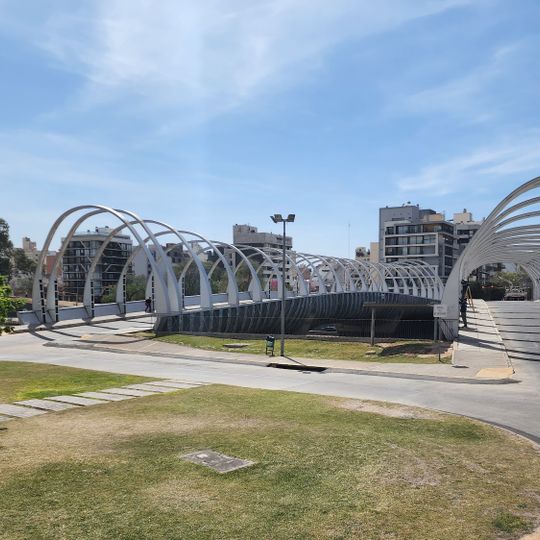
Bicentennial Bridge consists of two parallel reinforced-concrete spans of 80 m each over the Suquía River, in the Nuevo Centro Cívico area. Each span is divided into sections of 25, 30 and 25 m, with two 7 m roadways and 2.50 m pedestrian walkways. Nested semicircular metal arches painted light gray rise from the deck, and traffic signals hang from arms projecting inward near the top.
The two 80-metre reinforced-concrete spans, each made of sections of 25, 25 and 30 metres, were built by Electroingeniería SA over the Suquía River in the new Centro Cívico area. The crossing was inaugurated on 29 June 2011, twenty days ahead of the estimated deadline, linking the General Paz and Juniors neighbourhoods with the city centre. Two roundabouts and a level crossing over the Mitre railway tracks were added to connect it to Avenida Perón.
The two bridges are named for the bicentenary of the May Revolution, marked in 2010, and were opened on 29 June 2011, twenty days ahead of the estimated deadline. They were built by Electroingeniería SA to link the General Paz and Juniors neighbourhoods with the city centre. The street Rosario de Santa Fe was switched to east-west running between Bv. Guzmán and Chacabuco as part of the works.
The two 80-metre spans carry two 7-metre lanes each, with 2.50-metre pedestrian pavements on the sides. Access from the north side runs through two roundabouts and a level crossing over the Mitre railway tracks, controlled by barriers and signals, before reaching Avenida Perón. A slip road from Avenida Costanera norte leads up to the 24 de Septiembre bridge.
The two parallel spans each measure 80 metres, split into sections of 25, 30 and 25 metres, with 7-metre roadways and 2.50-metre pedestrian walkways. The work was finished 20 days ahead of the estimated deadline.
The community of curious travelers
AroundUs brings together thousands of curated places, local tips, and hidden gems, enriched daily by 92,815 contributors worldwide.