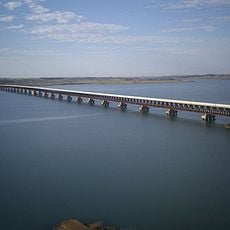
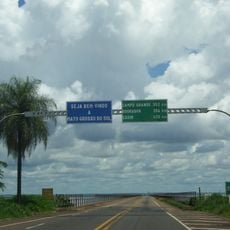
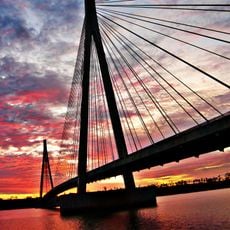
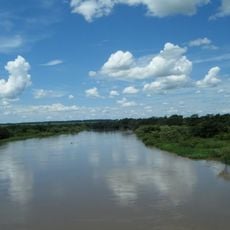
Puente Francisco de Sá, Railway bridge over the Paraná River between São Paulo and Mato Grosso do Sul, Brazil
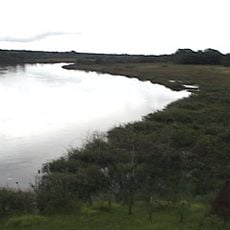
Puente Francisco de Sá spans across the Paraná River, connecting the states of São Paulo and Mato Grosso do Sul. The steel structure was built to serve as a railway link for cargo transport between the two states.
Construction of the Estrada de Ferro Noroeste do Brasil began in 1905, and the line reached Corumbá in 1914, but the Paraná was crossed by ferry: two locomotives, one on each bank, loaded and unloaded wagons onto iron barges pushed by the tugboats Conde Frontim and Marechal Hermes. A wooden bridge project approved in 1918 was dropped for a steel structure, inaugurated in 1926. The bridge honours Francisco Sá, minister of transport and public works during its construction.
The bridge represents a milestone in Brazilian railway engineering, connecting São Paulo's economic center with the agricultural regions of Mato Grosso do Sul. It enabled direct rail transport of goods between these economically distinct regions.
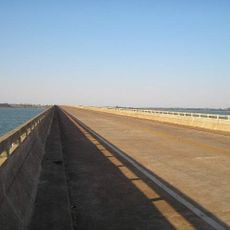
The bridge carries the railway between the São Paulo bank at Jupiá and Três Lagoas, crossing the Paraná at a point where the river is wide. It is a railway bridge, so there is no pedestrian walkway; the steel span and the river crossing are best seen from the banks near the old Jupiá station on the São Paulo side.
The metal structure originally planned for this bridge required modifications in 1918 when engineers realized it could not support the weight of modern trains. These changes resulted in a more robust design that has proven reliable in service.
The community of curious travelers
AroundUs brings together thousands of curated places, local tips, and hidden gems, enriched daily by 94,206 contributors worldwide.