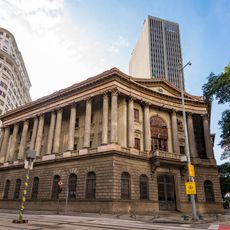
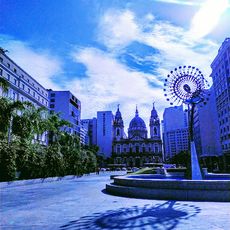
Church of the Third Order of Saint Francis of Penitence, Baroque church in Centro, Rio de Janeiro, Brazil.
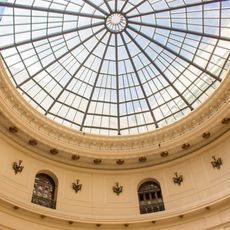
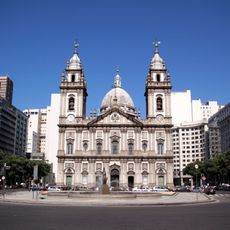
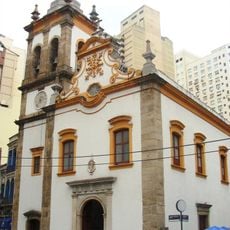
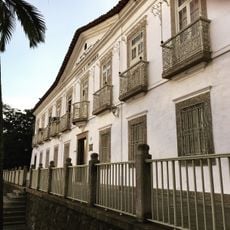
The Church of the Third Order of Saint Francis of Penitence stands beside the Convent of Santo Antônio on Morro de Santo Antônio. Its facade is divided into three bodies, each with a portal, two large windows and its own roof; the portals are of lioz stone brought from Portugal, and the central one has twisted quoins and a medallion with the order's coat of arms. Inside, a single rectangular nave is covered by gilded carving by Manuel de Brito and Francisco Xavier de Brito (1726–1743) and a wooden ceiling painted by Caetano da Costa Coelho (1736–1741).
Lay members of the Third Order of Saint Francis settled in Rio de Janeiro in 1619, using a chapel inside the Convent of Santo Antônio on the hill of the same name. In the mid-17th century the Franciscans donated land beside the convent church, and the order's own church was built with interruptions between 1657 and 1733. In the 18th century the order also built the Hospital de São Francisco da Penitência on the Largo da Carioca; it was moved to Tijuca and demolished during Mayor Pereira Passos's early-20th-century reforms.
The Third Order of Saint Francis, lay Franciscans, settled in Rio in 1619 and worshipped in a chapel inside the Convent of Santo Antônio before building this church. The Sacro Franciscano Museum, proposed by the order's administrators on 28 January 1932 and opened on 17 September 1933, was organised by José Francisco Felix de Mariz of the National Historical Museum.
The church stands beside the Convent of Santo Antônio on the Morro de Santo Antônio, in Rio's Centro, not on Rua da Carioca. Reach it on foot from Largo da Carioca, the square at the foot of the hill. It now operates as a sacred art museum, and the visit is combined with the neighbouring convent; the Sacro Franciscano Museum opened on 17 September 1933.
The ceiling painting by Caetano da Costa Coelho, finished in 1741, is the first in Brazil to simulate perspective. Coelho went on to gild the carving at the São Bento monastery in Rio in 1742. The Sacred Franciscan Museum opened in the church on 17 September 1933, organized by José Francisco Felix de Mariz of the National Historical Museum.
The community of curious travelers
AroundUs brings together thousands of curated places, local tips, and hidden gems, enriched daily by 92,804 contributors worldwide.