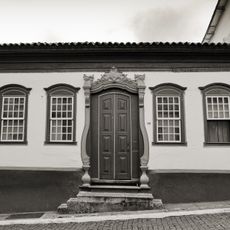
Church of the Archbrotherhood of Saint Francis of Assisi, Colonial church in Sabará, Brazil.
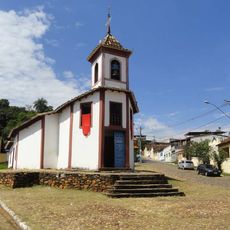
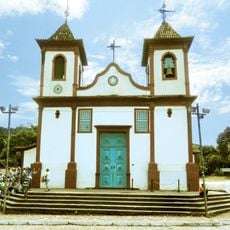
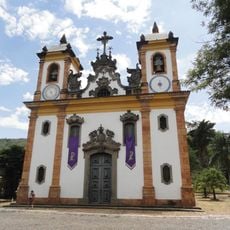
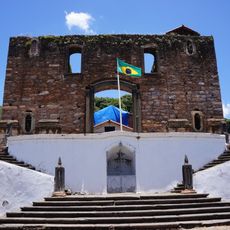
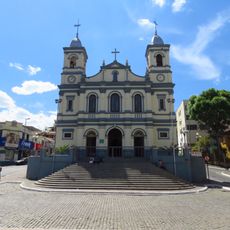
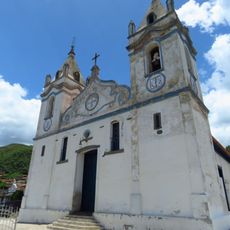
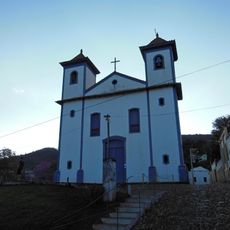
The Church of the Archbrotherhood of Saint Francis of Assisi has a single nave and a chancel, built in stone masonry. The facade has a central door crowned by a relief, a niche and a Franciscan emblem, with two balconied windows above and an undulating pediment between two bell towers with pyramidal spires. The chancel holds a large wooden altar shaped like a stepped throne and a ceiling painting of Our Lady of the Angels with the Evangelists.
The temple began in 1761 as a simple chapel of the Archconfraternity of the Cord of Saint Francis of the Brown Men, dedicated to Our Lady Queen of the Angels. On 6 July 1772 the brotherhood received permission to build a large church, but being poor, work advanced slowly and was never fully finished. Activity picked up between 1798 and 1805; the towers were completed in 1849, and the old chapel inside the walls was dismantled only in 1864.
The brotherhood that built it was the Archconfraternity of the Cord of Saint Francis of the Brown Men, founded in 1761, which first dedicated a simple chapel to Our Lady Queen of the Angels. Holy Week remains central: on Holy Thursday the tomb of Christ is opened with the venerated image of the Lord Dead, and the night is kept in a vigil, the Velório de Cristo, a tradition of some 300 years. The Procissão do Fogaréu, founded around 1850, leaves from here toward the chapel of Nosso Senhor Bom Jesus carrying the image of Our Lady of Sorrows.
The church stands on a slope in Sabará's historic centre, so the approach is uphill and the surrounding streets are steep and cobbled. The interior is entered through the central portal beneath the Franciscan emblem; the chancel, with its painted ceiling and stepped altar, lies beyond the transept arch. The nave's side altars and pulpits are best seen in morning light. The building is an active parish church and IPHAN-listed monument, so visitors keep to the aisles during services.
The primitive chapel of 1761 survived inside the new walls until 1864, when it was finally dismantled; the church was never fully finished. The stone-sabão relief of the portal is by Domingos Pinto Coelho, active in 1822, who also carved the oversized Our Lady of the Angels and the Dead Lord under the altar table.
The community of curious travelers
AroundUs brings together thousands of curated places, local tips, and hidden gems, enriched daily by 92,871 contributors worldwide.