Palácio Rio Branco, Government palace and museum in Rio Branco, Brazil.
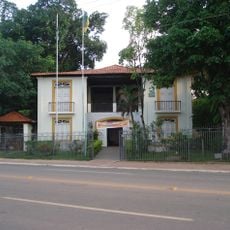
Palácio Rio Branco is a neoclassical building at the center of Rio Branco, distinguished by its white facade, symmetrical windows, and columns framing the main entrance. Inside, exhibition spaces and administrative rooms document the region's history and development.
The foundation stone was laid on 15 June 1929, during Hugo Carneiro's governorship, largely by workers of the Public Force of the Territory of Acre. The palace was inaugurated unfinished in 1930 and completed gradually, with full inauguration under Guiomard Santos. After decay in the 1980s and 1990s, Jorge Viana revitalized it as a museum of Acre's history.
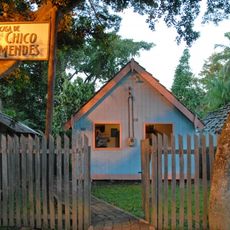
The palace museum holds collections on Acre's history, including the rubber-tapper era, the Acrean Revolution, the empates and the struggle of Chico Mendes, and displays part of the state's archaeological heritage such as the geometric geoglyphs of the Acre valley. In its architectural complex stands the Obelisk of Acre, erected in memory of the heroes of the Acrean Revolution.
The palace opens Tuesday to Sunday, holidays included, at Avenida Getúlio Vargas in the Centro. Visits cover the museum rooms and the Obelisco do Acre on the grounds. In 2007 it received 40,309 visitors, so groups may find the halls busy.
The palace's museum complex also holds the Obelisk of Acre, raised in memory of the heroes of the Acrean Revolution. The building itself was inaugurated unfinished in 1930 and only completed under Governor Guiomard Santos. By 2007 it had received 40,309 visitors, nearly double the 22,000 of 2006.
The community of curious travelers
AroundUs brings together thousands of curated places, local tips, and hidden gems, enriched daily by 92,837 contributors worldwide.