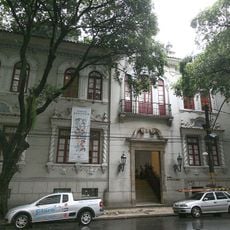
Church and Monastery of Our Lady of Grace, Catholic colonial monastery in Salvador, Brazil
The Church and Monastery of Our Lady of Grace consists of a single-nave church with a two-story monastery around a cloister, built in stone and brick. The church has three altars: the central one dedicated to Our Lady of Grace, the right to Saint Joseph, and the left to the Sacred Heart of Jesus. Its tower ends in an orange-shaped dome, a remnant of Mozarabic technique. The nave ceiling was painted by José Teófilo de Jesus and later altered by Manuel Lopes Rodrigues.
The complex began as a small chapel in 1535 and was later expanded into a monastery for Benedictine monks, becoming an important religious center. The monks remained there for centuries, shaping the building through ongoing improvements and additions.
The church keeps the image of Our Lady of Grace said to have been found among the indigenous people after a shipwreck around 1530–1535, possibly the Madre de Dios; Catarina Paraguaçu recognised it as the woman of her vision. The nave ceiling was painted by José Teófilo de Jesus and altered in 1881 by Manuel Lopes Rodrigues, who also painted O Sonho de Paraguaçu.
The church is closed for renovation and cannot be visited. It stands on a hill in the Graça neighborhood, south of Salvador's Historic Center and above the Bay of All Saints. Check locally before planning a visit, as no reopening date is given.
The site holds the remains of a native Brazilian woman who lived in the early 1500s and received baptism in France during her time overseas. Her story connects indigenous, European, and African influences that shaped Salvador's colonial beginnings.
The community of curious travelers
AroundUs brings together thousands of curated places, local tips, and hidden gems, enriched daily by 92,821 contributors worldwide.