Church of Saint Antony of Barra, Renaissance Catholic church in Barra district, Salvador, Brazil
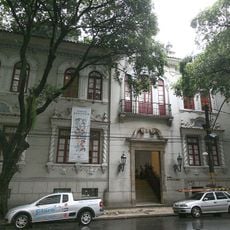
The Church of Saint Antony of Barra is a stone-and-lime masonry church with a single nave, a chancel, a sacristy and a meeting room. Its façade has a triangular classical pediment with a small oculus, three portals and four choir-level windows, flanked by two tiled pyramid-roofed bell towers. An external staircase leads to the upper floor.
The church was likely founded in the last years of the 17th century, in Vila Velha, Salvador's first colonisation settlement; little else about its early history is documented. It was listed, structure and contents, by IPHAN in 1938 under inscription 122 in the Fine Arts book. The woodcarving of the chancel was completed by Candido Alves de Souza (1840-1884) in the late 19th century.
The church is one of three in Salvador dedicated to Saint Anthony of Padua, the Lisbon-born Franciscan; it belongs to the Archdiocese of São Salvador da Bahia. Its name ties it to the old Vila Velha, the city's first colonisation settlement, where it was founded at the end of the 17th century. It remains an active Catholic temple open to the public.
The church stands on a hillside directly above Forte de São Diogo, at the southeast tip of Salvador, and is visible above Porto da Barra Beach. It is open to the public and may be visited. The upper floor is reached by an external staircase, a feature common to early Bahian churches.
The upper floor is reached by an external staircase, a feature common to early churches in Bahia. The chancel carvings were completed in the late 19th century by Candido Alves de Souza (1840-1884). The church sits directly above Forte de São Diogo, and from Porto da Barra beach it is visible to the north.
The community of curious travelers
AroundUs brings together thousands of curated places, local tips, and hidden gems, enriched daily by 92,805 contributors worldwide.