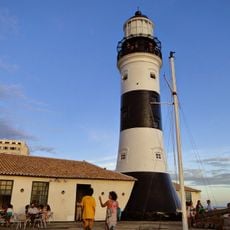
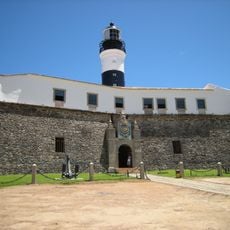
Forte de Santa Maria, Colonial fortress at Porto da Barra Beach, Salvador, Brazil
Forte de Santa Maria is a heptagonal stone fortress positioned on a narrow strip of land at Porto da Barra Beach. The structure features thick curtain walls oriented toward the Atlantic Ocean, creating a compact defensive installation.
The first fort on the site was built from 1614 to a design by Francisco de Frias da Mesquita. From 1624 to 1694 it formed a unified command with the Forte de Santo Antônio da Barra and the Forte de São Diogo, and in April and May 1638 the three cross-fired to repel Dutch forces under Maurice of Nassau. The present stone-and-lime structure dates from 1696, ordered by Governor-General João de Lencastre to a design attributed to José Pais Esteves.
A commemorative plaque to the right of the Portão de Armas records the Dutch landing of 9 May 1624 under Albert Schonten and the arrival of the first restoring troops of D. Fadrique de Toledo Osório on 30 May 1625, placed by the IGHB in 1938. The Imperial coat of arms above the entrance survived the proclamation of the republic in 1889.
The fort is closed to the public and cannot be visited; it has remained closed since the Navy transferred it to the Secretariat of Patrimony of the Union in 2001. It stands offshore from Porto da Barra beach and is reached by a narrow embankment, so it is seen from the sand or the water. The walls are damaged and unpainted for lack of maintenance.
A commemorative plaque to the right of the Portão de Armas records that Dutch troops under Albert Schonten landed here on 9 May 1624, and that the first restoring troops of D. Fadrique de Toledo Osório arrived on 30 May 1625. The Imperial coat of arms above the entrance survived the proclamation of the Brazilian Republic in 1889.
The community of curious travelers
AroundUs brings together thousands of curated places, local tips, and hidden gems, enriched daily by 92,813 contributors worldwide.