Forte de Santo Antônio da Barra, Fortress and lighthouse in Barra, Salvador, Brazil
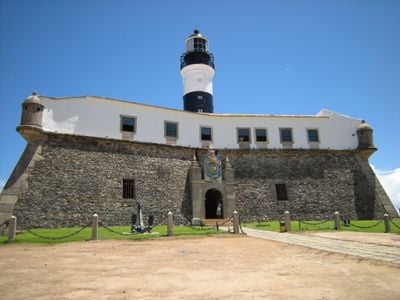
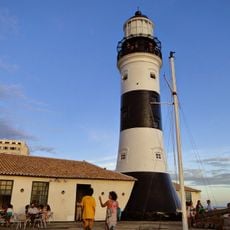
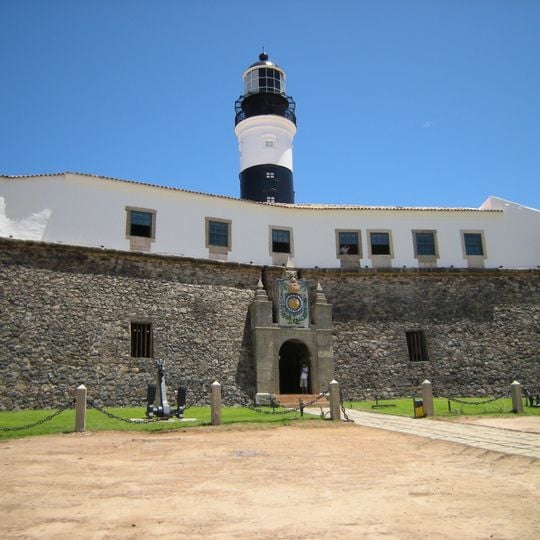
Forte de Santo Antônio da Barra is a squat stone fortress at the tip of Padrão, now the Largo do Farol da Barra, in Salvador. Its lower half is rough grey masonry with an arched gateway under a coat-of-arms panel; above runs a long white wall with seven dark windows under a terracotta tiled roof. From the centre rises the 22-metre Barra Lighthouse, a white tower with two wide black bands and a glass lantern under a domed black cap.
A first earthwork fort was raised on the Ponta do Padrão between 1583 and 1587 under governor-general Manuel Teles Barreto, and rebuilt in stone and lime from 1596 to a plan attributed to Leonardo Torriani. The Dutch took it without resistance on 9 May 1624; the following year four thousand men landed under its artillery to retake Salvador. The present structure was built from 1696 under João de Lencastre, when a lighthouse with a glazed bronze lantern burning whale oil was installed, the first in Brazil and the Americas.
The Nautical Museum of Bahia inside displays maritime objects, shipwreck artifacts, and navigation tools that tell the story of the region's ocean trade. Visitors can see how sailing and fishing shaped daily life and commerce in this coastal settlement.
The fortress is open daily and allows visitors to explore both the courtyard and lighthouse tower at their own pace. The site is easy to reach on foot, with flat walkways inside and clear signage to help you navigate the structures.
In 1705 the Salvador city council asked that Saint Anthony of Lisbon be enlisted in the fort as captain, with his pay going to the syndic of the Convent of São Francisco; the Crown approved by decree on 7 April 1707. Later decrees of 13 September 1810 and 25 November 1814 promoted the saint to major and lieutenant-colonel.
The community of curious travelers
AroundUs brings together thousands of curated places, local tips, and hidden gems, enriched daily by 93,009 contributors worldwide.