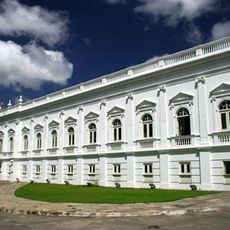
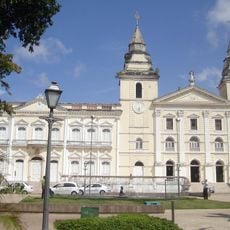
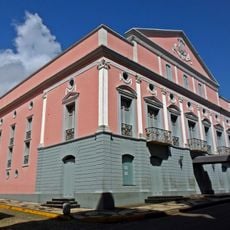
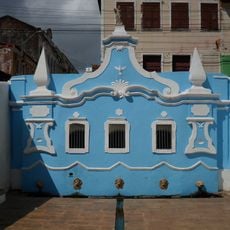
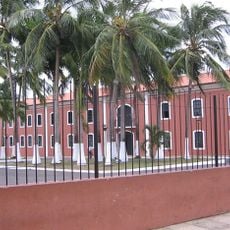
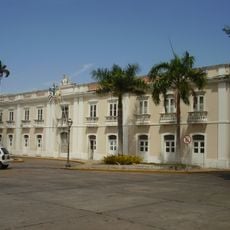
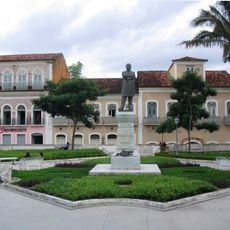
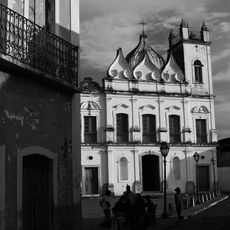
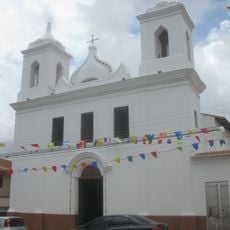
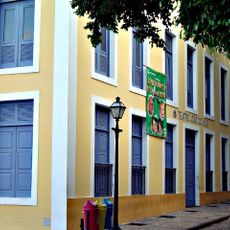
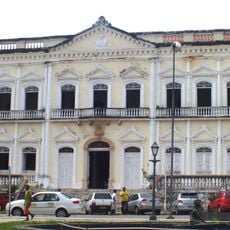
Convento e Igreja de Nossa Senhora do Carmo, Religious complex in São Luís, Brazil.
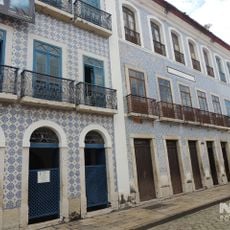
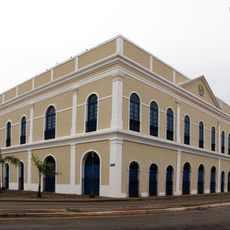
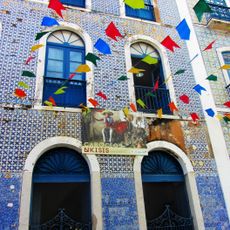
The Convento e Igreja de Nossa Senhora do Carmo stands on Praça João Lisboa, run by the Capuchin Order. The church has a symmetrical baroque facade with two plain side towers topped by iron crosses, a triangular pediment between them, and three windows with iron balconies above the main door. The facade was covered in azulejo tiles in 1866; the convent has two floors with seven windows facing the largo.
Three Carmelite friars arrived in São Luís in 1624 with friar Cristóvão de Lisboa and received land from governor Alexandre de Moura; the present convent rose in 1627 on the site of a chapel to Santa Bárbara. Dutch invaders damaged its towers and walls between 1640 and 1644, and the convent later housed the first public library of Maranhão and the first seat of the Liceu Maranhense. The Capuchins took over the complex in 1894.
The interior displays traditional Portuguese building elements that arrived during the colonial period, reflecting the religious connection between Brazil and Portugal. Visitors can still see today the craftsmanship that preserved this bond in stone and art.
The complex is accessible during regular visiting hours and remains an active place for religious ceremonies and community functions. It is advisable to check opening hours in advance and observe respectful behavior during services.
The azulejo cladding on the facade dates from 1866 and is likely one of the few original elements, together with the main door. The 1943 renovation replaced the front staircase with a forecourt with two side stairs and demolished part of the convent's right wing, reducing its windows.
The community of curious travelers
AroundUs brings together thousands of curated places, local tips, and hidden gems, enriched daily by 92,955 contributors worldwide.