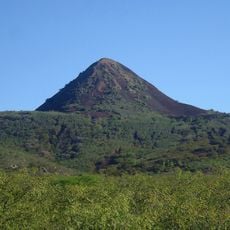
Pico do Cabugi, Extinct volcano in Angicos, Brazil.
Pico do Cabugi is a 590 m conical peak of alkaline basaltic rock in Angicos, Rio Grande do Norte, rising from a flat, scrub-covered plain. Its lower slopes carry mottled green and brown vegetation with patches of bare ground; near the rounded summit the cover thins and the rock turns dark reddish-brown. Erosion has left it shaped like a lava dome, and it keeps its original volcanic form.
The mountain formed during the Tertiary period through volcanic activity, with the rocks dating back about 19 million years. This ancient origin makes it an important window into Brazil's geological past.
Cabugi comes from the Old Tupi kaba (wasp) and jy (river), meaning "river of wasps", possibly naming a watercourse that once ran nearby. The peak's outline is widely reproduced in Rio Grande do Norte, and cabugi is used as a metonym for the state itself.
The summit stands at 590 m, so altitude sickness is not a concern; the real difficulty is the heat of the sertão. The peak lies in the Cabugi Ecological State Park in Angicos, on the road between Natal and Mossoró, and is reached by trail from the park entrance. Bring water and sun protection, and go early.
The rocks contain small xenoliths that originated deep beneath the Earth's surface, offering clues about underground geological processes. These rare inclusions make the mountain a special place for understanding the planet's inner layers.
The community of curious travelers
AroundUs brings together thousands of curated places, local tips, and hidden gems, enriched daily by 92,894 contributors worldwide.