Succulent Karoo, Desert ecoregion in South Africa and Namibia
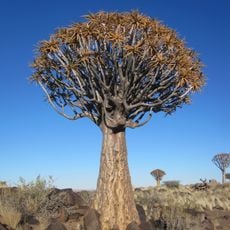
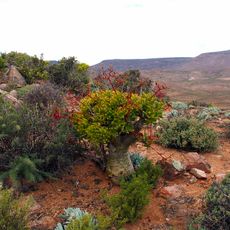
The Succulent Karoo is a desert ecoregion stretching across southwestern Africa, spanning South Africa and Namibia with more than 6,000 plant species. These plants are specially adapted to survive the dry climate and occasional winter rainfall that shapes this landscape.
The Succulent Karoo was delineated by the WWF as an ecoregion covering desert tracts of South Africa and Namibia, and Conservation International later designated it a biodiversity hotspot. Its extent does not match the historic Karoo proper. Conservation South Africa has supported land management and stewardship here and ran a small-grants fund called SKEPPIES.
The name Namaqualand belongs to a region lying almost entirely inside the Succulent Karoo, not the Nama Karoo as the name suggests. The winter-rainfall pattern that defines the ecoregion is what brings the yellow daisy-like blooms and bulbous plants into flower, and the spring displays draw visitors who come specifically to see them.
Rain falls in the cold winter months, from 20 mm to 290 mm a year, so the flowering follows winter rain rather than mid-year heat. Along the coast the cold Benguela Current brings frequent fog that softens the climate; inland the Southern Karoo has more irregular rain and mountains above 1,500 m. The ecoregion covers 102,700 km², so plan for long distances between stops.
This region is home to roughly one-third of all succulent plant species on Earth, with about 40 percent of them found nowhere else. This makes it one of the most botanically varied places on the planet despite its dry conditions.
The community of curious travelers
AroundUs brings together thousands of curated places, local tips, and hidden gems, enriched daily by 92,916 contributors worldwide.