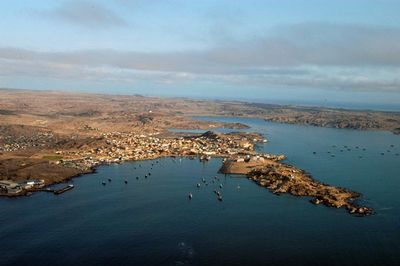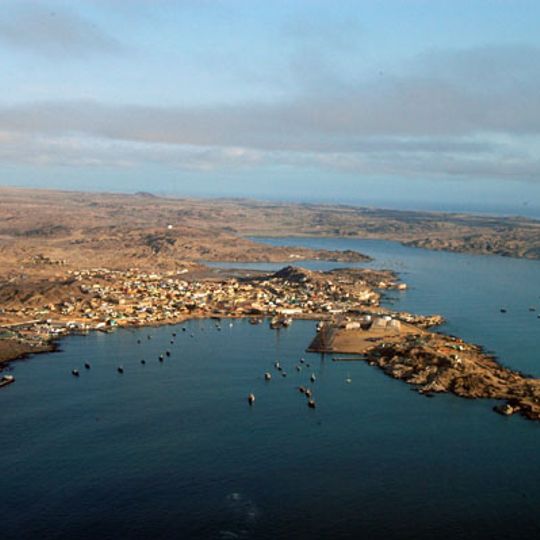
Port of Lüderitz, Commercial port in Lüderitz, Namibia.
The Port of Lüderitz, historically Robert Harbour, lies in a shallow bay with a rocky seabed on the edge of the Namib desert, beside the Sperrgebiet diamond area. A 500-metre quay inaugurated in 2000 lets ships of up to 8.75 metres draught moor at its outer end; smaller vessels of up to six metres previously used the bay. Namport operates it, one of Namibia's two ports.
The harbour was originally a fishing port. From the mid-1990s it developed into a transshipment point for minerals from surrounding mines and South Africa's Northern Cape, and for fruit exports, especially table grapes. A new 500-metre quay was inaugurated in 2000, letting ships with up to 8.75 m draught berth at its outer end. In September 2010 operator Namport announced expansion into the country's second major port; in February 2018 a new port was questioned on environmental grounds, and further expansion was announced in mid-2025.
The harbour's name recalls Robert, and it is still known as Robert Harbour in English. Since the mid-1990s its role has shifted from a fishing port to a transhipment point for minerals from mines in the surrounding area and South Africa's Northern Cape, and for fruit exports, table grapes in particular. Namport, which also runs Walvis Bay, operates it.
The port lies at the edge of the Diamantensperrgebiet and is reached from Keetmanshoop by the B4 national road and, since 2015, the Lüderitz railway. It is a working Namport facility, so access to the quay is not open to visitors; the 500-metre quay, inaugurated in 2000, berths ships drawing up to 8.75 metres at its outer end.
The bay's rocky seabed long limited Lüderitz to ships drawing at most six metres. The 500-metre quay inaugurated in 2000 lets vessels of up to 8.75 metres berth at its outer end, so the depth constraint was eased by extending outward rather than dredging.
The community of curious travelers
AroundUs brings together thousands of curated places, local tips, and hidden gems, enriched daily by 93,989 contributors worldwide.