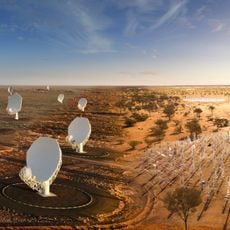
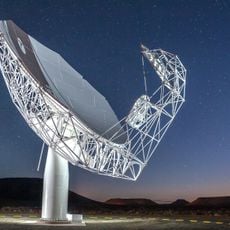
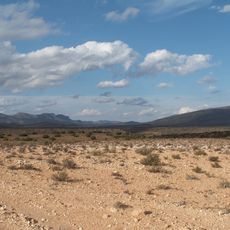
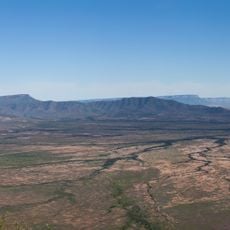
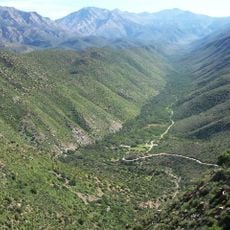
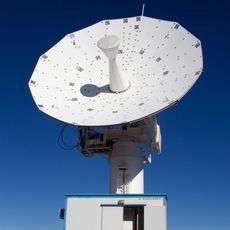
KAT-7, Radio interferometer in Meerkat National Park, South Africa.
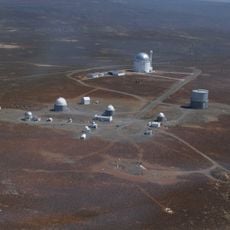
KAT-7 is a radio interferometer of seven 12-metre prime-focus dishes in the Meerkat National Park, Northern Cape, South Africa. It was the first radio telescope built with a composite reflector and uses a Stirling pump for 75 K cryogenic cooling. Built as the engineering test bed for MeerKAT, it became a science instrument in its own right.
The radio interferometer was completed in 2011 as an experimental platform to test new technologies for advanced telescope systems. It laid groundwork for the development of larger astronomical observation arrays in the region.
KAT-7's name comes from the Karoo Array Telescope, the project that preceded MeerKAT. Its ROACH correlators were designed and built in Cape Town and are now used by telescopes elsewhere in the world. The array also served as a technology demonstrator for South Africa's bid to host the Square Kilometre Array.
The site is located in a remote protected area, so you need to plan your visit in advance and check access requirements beforehand. The surrounding region has specific rules to protect the natural environment and research operations.
The facility achieved a milestone by connecting just four of its antennas and successfully detecting extremely faint signals from space. This breakthrough showed that the interferometry method could work effectively in this particular location.
The community of curious travelers
AroundUs brings together thousands of curated places, local tips, and hidden gems, enriched daily by 93,771 contributors worldwide.