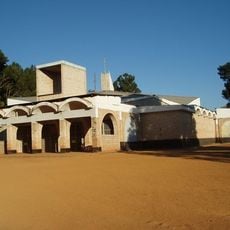
Mwela Rock Paintings, National monument with Later Stone Age rock paintings in Kasama District, Zambia
Mwela Rock Paintings is a petroglyphic site containing over 1,000 paintings spread across multiple rock outcrops in Zambia's northern region. The artwork covers caves and rocky shelters, displaying the creative expressions of ancient peoples who lived in this landscape.
The paintings are attributed to Later Stone Age hunter-gatherers known as Batwa or Twa, made in the red tradition and estimated at up to 2000 years old, with Russian sources suggesting 1000 to 7000 years. Excavations in a cave in the region found Late Stone Age tools similar to those from Nachikufu Cave, plus traces of Early Iron Age culture. The site was recognised as early as 1945 and declared a National Monument in 1964 under Government Notice No. 255.
The red-tradition paintings were made by Batwa hunter-gatherers, ancestors of Bantu-speaking farmers. Animal figures were painted with a fine brush, geometric designs usually with a finger. At Lwimbo and Mwela-Chama, human figures stand beside a dying antelope in a pose read as a ritual dance; in Sumina's Lion Cave a man spears a lion over a buffalo. Some circles are interpreted as sun or rain-cloud signs.
Visitors should arrange transportation from Kasama to reach the site and bring adequate water supplies for the visit. Sturdy footwear is essential because the terrain is rocky and uneven in many areas.
In the Lwimbo outcrops and at Mwela-Chama, anthropomorphic figures stand beside a dying antelope, arranged in a half-circle with heads turned toward the animal; researchers read the poses as a ritual dance. In Sumina's Lion Cave, a human figure stands over a dead buffalo, apparently spearing a lion. Stylistic parallels suggest the same artist made both scenes.
The community of curious travelers
AroundUs brings together thousands of curated places, local tips, and hidden gems, enriched daily by 94,534 contributors worldwide.