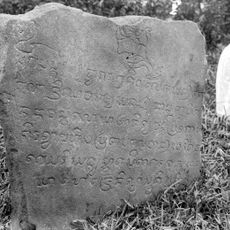
Prasasti Kuburajo I, Sanskrit stele in Limo Kaum, Indonesia.
Prasasti Kuburajo II is the central of three large aligned andesite stones at Kuburajo, Tanah Datar, arranged like seats for meetings of traditional heads. The grey-black stone measures 145 cm high, 63 cm wide and 84 cm thick, and bears eight lines in Old Javanese script and a mixed Sanskrit-Old Javanese language.
The Kuburajo II inscription is attributed to the reign of King Adityawarman, who ruled in Sumatra in the 14th century. Its eight lines mix Sanskrit and Old Javanese, and the words puri and sthana likely refer to the royal palace. The left stone's bulus ornament encodes 1261 Saka, or 1339 CE, while the right stone's decoration gives 1273 Saka, or 1351 CE.
The inscription invokes Sri Lokeswara and blends Sanskrit with Old Javanese script, showing the Hindu-Buddhist heritage that shaped medieval Sumatra. These language combinations reveal how different spiritual traditions coexisted and influenced local expression.
The stone sits in an accessible location and is fitted with protective supports to prevent damage. Visitors should approach carefully and respect the installation, as the carved surface can be fragile.
The text mentions Kanaka Medinindra, a term parallel to Suwarnna Bhumi, pointing to West Sumatra's substantial gold wealth during medieval times. This reveals the region was economically important beyond its spiritual standing.
The community of curious travelers
AroundUs brings together thousands of curated places, local tips, and hidden gems, enriched daily by 94,557 contributors worldwide.