Kete Kesu, Traditional village in Tana Toraja, Indonesia.
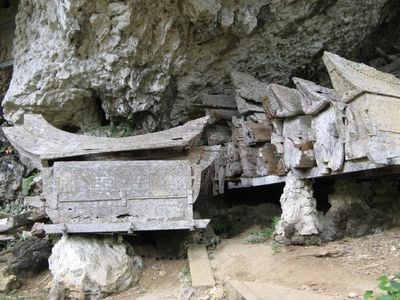
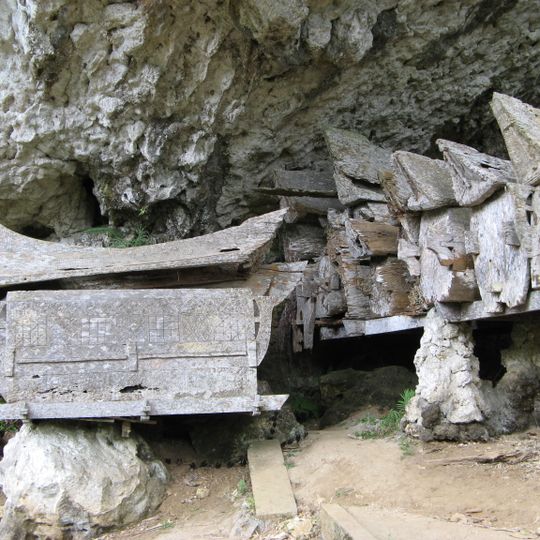
Kete Kesu is a Toraja village of six tongkonan houses and twelve rice barns, their steep roofs curving upward above wooden posts and carved gable panels. About 50 metres away, boat-shaped erong coffins rest on a pale limestone outcrop, some carved with geometric motifs, while others take buffalo or pig form.
Kete Kesu's rock graves, about 50 metres from the village, are estimated at over 500 years old, older than the tongkonan houses, some of which are thought to be around 300 years old. The dead were placed in erong coffins carved as boats, buffaloes or pigs, hung on cliffs or set in caves. Later noble graves were added, and iron bars now close some tombs against theft of the tau-tau effigies.
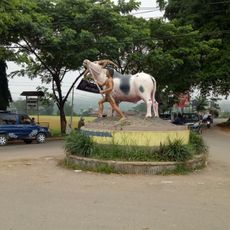
Kete Kesu is a centre for Toraja ceremonies: Rambu Solo funerals, where water buffalo are sacrificed over several days, and Rambu Tuka for new houses. Most rituals take place between June and December. Villagers are carvers and painters, and one tongkonan serves as a museum with old carvings, weapons, ceramics, Chinese cloth and a Red and White flag said to be the first raised in Toraja.
The settlement is best explored on foot, as pathways between houses are narrow and vehicle access is limited. Visit during drier months when roads are most accessible and walking conditions are easiest.
The traditional coffins, called erong, are not all boat-shaped: some are carved as buffalo or pigs, and the stone graves about 50 m from the village are estimated at over 500 years old. Some coffins have been fitted with iron bars to stop the theft of tau-tau effigies.
The community of curious travelers
AroundUs brings together thousands of curated places, local tips, and hidden gems, enriched daily by 94,094 contributors worldwide.