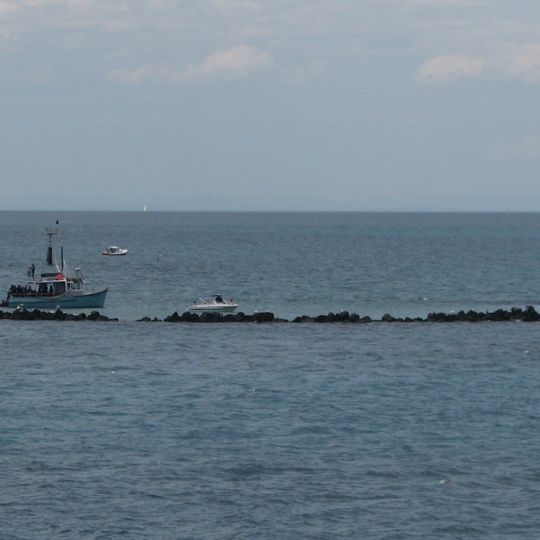
Pope's Eye, Sea fort in Port Phillip Bay, Victoria, Australia.
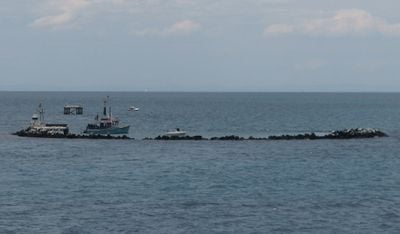
Pope's Eye is an unfinished island fort begun in the 1880s, when bluestone boulders were dumped on a submerged sandbank 12 metres deep until they formed a horseshoe-shaped artificial reef just above high-water level, open to the north-east. The inside of the eye is only about 2 metres deep, and the reef now carries a navigation beacon.
Construction began in the 1880s under Sir William Jervois, who had bluestone boulders dumped on a submerged sandbank 12 metres deep until they formed a horseshoe-shaped reef open to the north-east, just above high-water level. Work stopped before the fort was finished: better naval gunnery let guns at Swan Island, Fort Queenscliff and Fort Nepean cover The Rip and its shipping channel, so Pope's Eye was no longer needed.
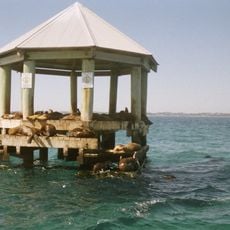
The name comes from a naval midshipman and carries no religious meaning. The rocks are a breeding site for Australasian gannets, which nest on platforms built for them as well as on the reef itself; black-faced cormorants roost there and ruddy turnstones forage. The site lies within the Swan Bay and Port Phillip Bay Islands Important Bird Area, identified by BirdLife International.
Pope's Eye lies about 7 km inside Port Phillip Heads, 3 km east of Queenscliff and 5 km north of Portsea. The horseshoe reef is open to the north-east, and its interior is only about 2 m deep, so small boats can enter and anchor sheltered from strong currents. The site is a protected marine reserve, and divers and snorkellers reach it by boat.
The name comes from a naval midshipman, not religion. The horseshoe opens to the north-east, and the enclosed water is only about 2 metres deep, so small boats use it as a sheltered anchorage away from the currents.
The community of curious travelers
AroundUs brings together thousands of curated places, local tips, and hidden gems, enriched daily by 93,366 contributors worldwide.