Flinders Street Viaduct, Railway viaduct in Melbourne, Australia
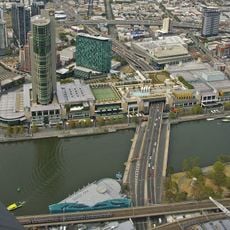
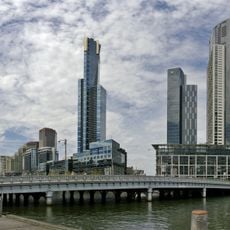
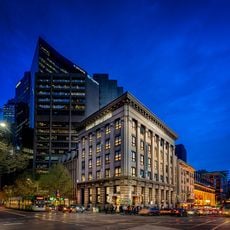
The Flinders Street Viaduct is a curving railway bridge of six tracks built at different times, linking Flinders Street station to Southern Cross station. The older four-track section runs on steel spans supported by brick pillars, while the two newer tracks, 722 metres long, use precast concrete box girders on concrete supports. It passes behind the former Victorian Railways headquarters at 67 Spencer Street, swings around the former Melbourne City Markets and Fish Market sites, and crosses over the Banana Alley Vaults.
A ground-level tramway link between Flinders Street and Spencer Street stations was authorised in 1879, but it could only be used at night and had a level crossing at Queensbridge Street. The Octopus Act of 1884 authorised a permanent link, and a single track on the viaduct opened in November 1891, with the double line opening for goods traffic the next month. Designed by engineer Frederick Esling, the viaduct was duplicated in 1915 to four tracks, and two more tracks were added in 1978 as part of the City Loop project.
The land beneath the viaduct has served changing uses: after the King Street Bridge opened in 1958 part of it became a City of Melbourne car impound yard, which ended in 2003. Since 1997 the newer viaduct has been lit at night by 'Blue Line', Peter McNeill-Stitt's artwork using 1,400 metres of neon tubing. A path beside Batman Park is named Rebecca Walk after the schooner Rebecca.
The viaduct curves behind 67 Spencer Street, turns east, then swings south around Northbank Place and north-east over the Banana Alley Vaults into Flinders Street station. The newer 1978 concrete section runs south of the older brick-pillared spans, so the two structures can be compared from the riverside path at Batman Park, where Rebecca Walk follows the Yarra.
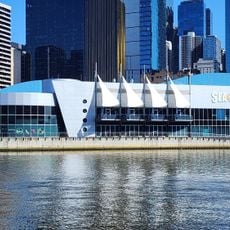
Beneath the viaduct sits the Melbourne Aquarium, built between 1998 and 1999, which incorporates the railway structure into contemporary urban space. This unexpected pairing shows how historic infrastructure can be repurposed for modern uses.
The community of curious travelers
AroundUs brings together thousands of curated places, local tips, and hidden gems, enriched daily by 93,632 contributors worldwide.