East Melbourne Lutheran church, Gothic Revival Lutheran church in East Melbourne, Australia
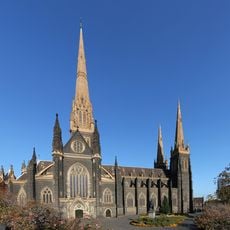
Lutheran Trinity Church is a bluestone church with a pitched slate roof, measuring 27 by 13 metres outside and 14 metres to the apex of its timber ceiling. Its basilica plan sets a nave apart from the aisles with five pointed, moulded arches on each side, carried on columns with foliated capitals. Stained glass by Ferguson and Urie fills the windows.
The congregation received half an acre on Parliament Place on 19 January 1853, and the first church, with its foundation stone laid on 27 September 1853, was dedicated on 11 June 1854. The present church replaced it: its foundation stone was laid on 17 March 1874 and it was dedicated on 22 November 1874. Architect Carl Blackmann, also known as Charles Blachmann, supplied the accepted plans free of charge, while John Koch later designed the 1890 manse.
Services have been held in German on this site since 1853, and the congregation still worships in German on most Sundays, with an English service every fourth Sunday. The first pastor, Matthias Goethe, was appointed on 25 March 1853; Hermann Herlitz led the congregation from 1868 to 1914.
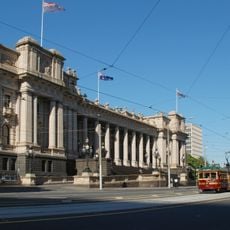
The church stands on Parliament Place, immediately south of St Patrick's Cathedral and east of Parliament House, so it is reached on foot from Parliament station. Services are mostly in German, with an English service on the fourth Sunday; visitors should time a visit around the service rather than expect open doors at other hours.
The pipe organ, dedicated on 16 May 1875, was built by Robert Mackenzie; it has been rebuilt twice but keeps its original pipework and case. The timber ceiling and the stained glass by Ferguson and Urie are named in the Victorian Heritage Register entry of 9 October 1974.
The community of curious travelers
AroundUs brings together thousands of curated places, local tips, and hidden gems, enriched daily by 93,376 contributors worldwide.