Argyle Cut, Historic cut in The Rocks, Sydney, Australia
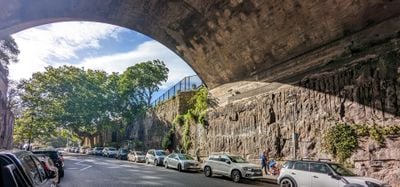
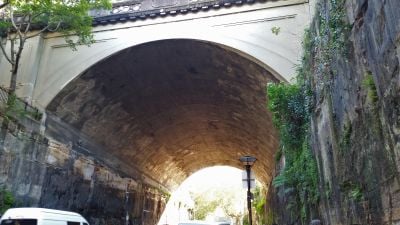
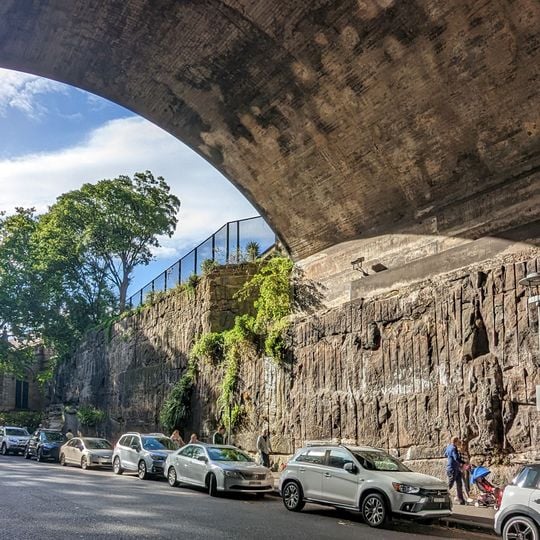
Argyle Cut is a deep rock cutting in The Rocks, Sydney, giving a direct connection between Millers Point and The Rocks. Its rough sandstone walls, scored with vertical drill marks, rise to a curving overhang, and a low metal fence runs along the top. Two bridges cross overhead: the Cumberland Street bridge of c. 1911 and the Bradfield Highway of c. 1930.
The Argyle Cut was begun in 1843 by convict chain gangs under overseer Tim Lane, but the government abandoned it half-finished after transportation to New South Wales ended in 1840. The Sydney Municipal Council completed the cutting with explosives and paid labour in 1859, using the spoil to fill the mouth of the Tank Stream and buttress the Circular Quay sea wall. Overhead bridges followed for Gloucester Street in 1862, Cumberland Street in 1864 and Princes Street in 1867–68.
The Rocks district, where the cut sits, is one of the oldest parts of Sydney and draws many visitors to its cobblestone streets, galleries, and small bars. Walking through the passage connects these areas in a way that feels ordinary today but required enormous effort to make possible.
The cut is an active road, so pedestrians should use the footpath along the side and stay aware of passing vehicles. Walking through during the day gives the best view of the rock walls, and the passage is easy to reach on foot from the surrounding streets of The Rocks.
The Argyle Stairs, built in 1911–12 when Gloucester and Cumberland Streets were realigned, still connect Argyle Street to Cumberland Street above the cut. An inscription on the south wall records the overhead bridges' completion in 1867–68 under Mayor Charles Moore, moved there after the Princes Street Bridge was demolished for the Harbour Bridge.
The community of curious travelers
AroundUs brings together thousands of curated places, local tips, and hidden gems, enriched daily by 94,043 contributors worldwide.