Cumbooquepa, Heritage-listed house in South Brisbane, Australia
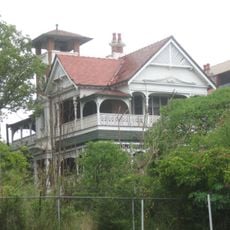
Cumbooquepa is a single-storey red-brick house on a patterned brick and stone base, with timber verandahs and terracotta-tiled and corrugated-iron hip roofs. Its symmetrical north facade, facing the Brisbane River, has bow-fronted corner pavilions linked by colonnades to a central entry pavilion topped by a tower, with rendered arches, pediments, quoins and Ionic pilasters.
Thomas Blacket Stephens, Brisbane's second mayor, acquired the land in 1856 and built the original timber dwelling before architect George Addison designed the current structure in 1890. The property was subsequently converted into a major educational institution and became part of Brisbane's urban development.
The name Cumbooquepa comes from the Stephens family's original timber house; the school title Somerville House, added in 1920, honours Mary Somerville, a Scottish scientist also linked to Somerville College, Oxford. Co-principals Constance Harker and Marjorie Jarrett led the girls' school from 1909, and a 1935 memorial library to Harker, with stained glass by William Bustard, is now a chapel.
Cumbooquepa stands on the highest part of Somerville House, a school campus on a triangular block bounded by Vulture Street to the north and the railway line to the west. The grounds are not open to the public; the house is best seen from Vulture Street, where its northern facade faces the city.
During World War II, the building became headquarters for Allied forces in the Far East, forcing the school to relocate temporarily. The institution returned to its campus in 1945 and has continued its educational mission since then.
The community of curious travelers
AroundUs brings together thousands of curated places, local tips, and hidden gems, enriched daily by 94,434 contributors worldwide.