Malia, Historic Hawaiian canoe in Honolulu County, US.
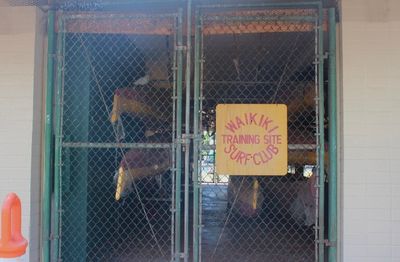
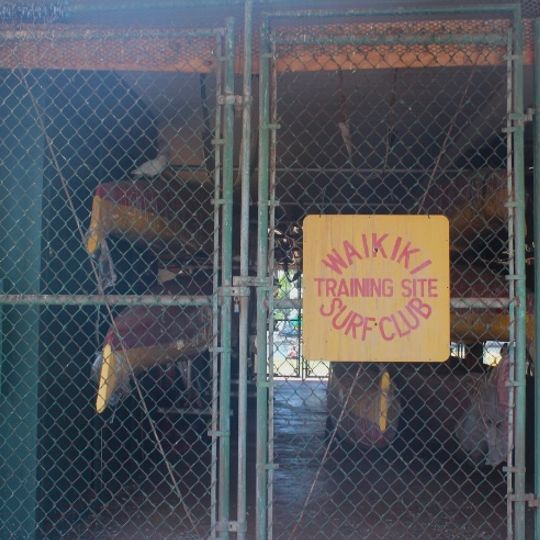
Malia is a roughly 40-foot, 400-pound Hawaiian racing canoe hewn from blonde koa wood by James Takeo Yamasaki in Kailua-Kona in 1933. Its long, narrow hull has a dark reddish-brown body with yellow sections at the bow and stern, and it rests behind a green chain-link fence bearing a yellow sign for the Waikiki Training Site Surf Club.
Mālia was carved from blonde koa wood at Kailua-Kona in 1933 by James Takeo Yamasaki, capping a design evolution that began with Prince Jonah Kūhiō Kalanianaʻole's racing canoe ʻAʻa of 1902. The Outrigger Canoe Club bought it in 1940 and the Waikiki Surf Club acquired it in 1948, keeping it in use until 1988. It won the first Catalina Island race in 1959 and was listed on the State and National Register of Historic Places in 1993.
The canoe's name derives from Mālie, referring to the calm waters of the Kona Coast on the leeward side of the Big Island, where it was carved in 1933. The Waikiki Surf Club acquired the canoe in 1948 and kept it in use until 1988; the yellow sign on the fence in front of it reads "WAIKIKI TRAINING SITE SURF CLUB".
The canoe is kept behind a chain-link fence at the Waikiki Training Site Surf Club, marked by a yellow sign with red lettering. It can be viewed from outside the fence; the hull is partly hidden, so the yellow upper sections and outrigger float are the clearest parts to see. The canoe is about 40 feet long and weighs 400 pounds.
The 1959 Catalina-to-Newport race brought the canoe to California, where a fiberglass shell of the Malia was reportedly taken without authorization while it waited to be shipped home. That shell became a mold, and molds made from it produced most of the fiberglass canoes later used in Hawaii and California.
The community of curious travelers
AroundUs brings together thousands of curated places, local tips, and hidden gems, enriched daily by 92,784 contributors worldwide.