Hale Solar Laboratory, Astronomical observatory in Pasadena, California, US.
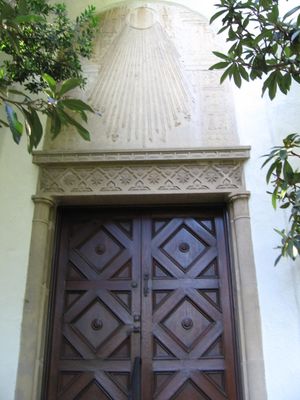
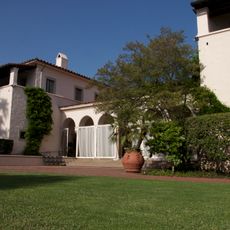
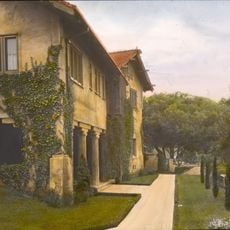
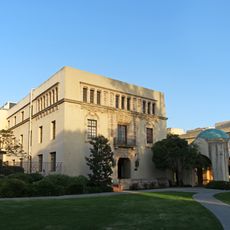
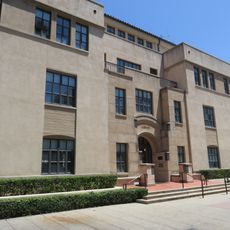
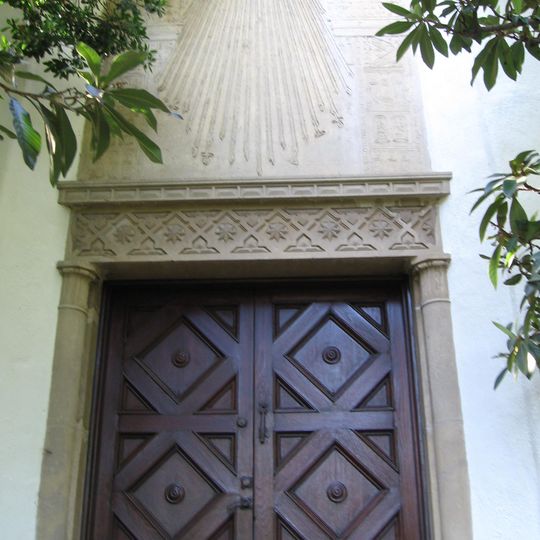
The Hale Solar Laboratory is a roughly T-shaped concrete building with a tile roof on Holladay Road in Pasadena. The stem of the T holds the telescope tower and George Ellery Hale's library, office and living area, while the top portion once housed electrical and ventilation equipment. The main entrance sits at the base of the tower, beneath an arch with an incised bas-relief tribute to the pharaoh Akhenaten.
George Ellery Hale built the Hale Solar Laboratory after retiring as director of Mount Wilson Observatory, and it was completed in 1923. The observatory was designed by Reginald Davis Johnson, Gordon Kaufmann and Roland Coate, with gardens planned by Beatrix Farrand. Hale refined the spectrohelioscope here, and the building was declared a National Historic Landmark in 1989.
The main entrance sits at the base of the telescope tower, framed by an arch carved with a bas-relief tribute to Akhenaten, the Egyptian pharaoh who worshipped the sun god Aten. The sun-focused motif ties the building's purpose to its ornament. The laboratory stands on private property in a residential area and is not open to the public.
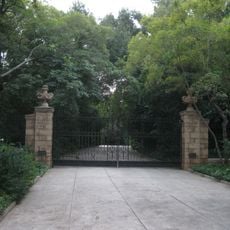
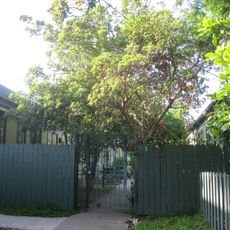
The laboratory stands on the east side of Holladay Road, between Lombardy and Orlando Roads, south of the Caltech campus. It sits well back from the street on private property, reached by a narrow tree-lined lane, and is not open to the public; the building is best seen from the street.
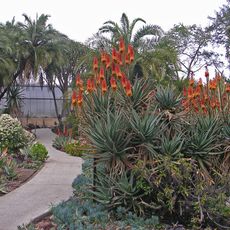
The building's main entrance sits at the base of the telescope tower, framed by an arch carved with a bas-relief tribute to Akhenaten, the Egyptian pharaoh who worshipped the sun god Aten. The gardens and landscape plan were designed by Beatrix Farrand.
The community of curious travelers
AroundUs brings together thousands of curated places, local tips, and hidden gems, enriched daily by 92,752 contributors worldwide.