Hole-in-the-Rock, Natural sandstone formation in Papago Park, Phoenix, United States.
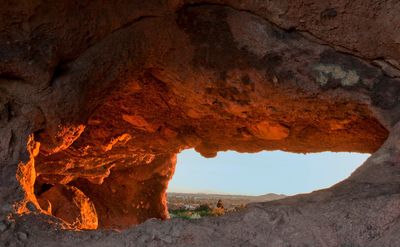
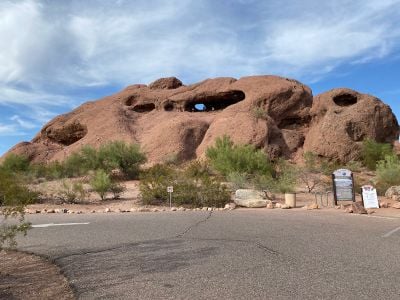
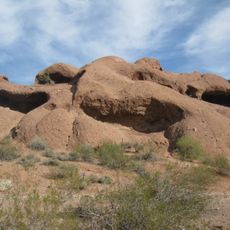
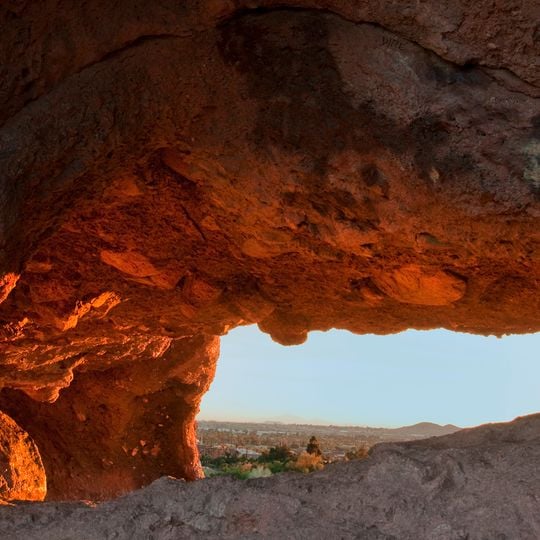
Hole-in-the-Rock is a small hill of bare red arkosic conglomeritic sandstone in Papago Park, its face hollowed into tafoni: an open, shelter-like chamber with a hole eroded completely through the rock to the rear and another substantial opening in the ceiling. A low grey rock ledge frames the view out over the landscape, and faint dark markings, one resembling "D17", sit on the upper right of the rock ceiling.
The red arkosic conglomeritic sandstone of Hole-in-the-Rock formed 6–15 million years ago from material eroded off a Precambrian granite that has since disappeared. The tafoni openings are thought to have been eroded by water. Charles Poston named and claimed the formation in 1892. The Hohokam used sunlight through the ceiling opening to mark the equinoxes and solstices, carving a slick metate area in the rock and placing boulders at other positions.
The name was given by Charles Poston, who claimed the formation in 1892. The Hohokam carved a smooth metate-like area in the rock and placed boulders at other spots to mark the equinoxes and solstices, using sunlight through the ceiling opening to track the seasons.
You can reach the formation through a gentle ascending path behind the hill or attempt a steeper climb on the front side. Both routes lead to the opening and provide different experiences depending on your fitness level and preference.
The passageway running through the rock maintains a steady airflow that becomes noticeable on hot days. This natural ventilation effect likely attracted early inhabitants and continues to make visits more comfortable in the desert heat.
The community of curious travelers
AroundUs brings together thousands of curated places, local tips, and hidden gems, enriched daily by 92,634 contributors worldwide.