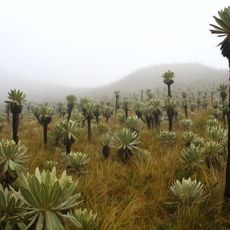
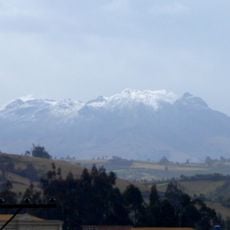
Chiles volcano, Stratovolcano at Colombia-Ecuador border.
Chiles volcano sits at the Colombia-Ecuador border and forms part of a larger volcanic complex with Cerro Negro. The mountain displays steep slopes and shows clear signs of ongoing volcanic activity through vents and gas emissions.
No major eruption is documented in historical times; a 1936 eruption reported by Ingeominas may actually have come from Ecuador's Reventador, and otherwise the volcano has not erupted for about 160,000 years. Since July 2013 the Chiles-Cerro Negro complex has shown increased seismicity, and on 20 October 2014 a M 5.8 earthquake was felt in Pasto and Quito. On 21 October 2014 the SGC raised the alert to orange after 4,300 quakes in 18 hours, and by late November over 132,000 had been recorded.
The volcano's name comes from the páramo de Chiles, whose streams feed the Carchi (Guáitara) river. Nearby Tufiño, in Tulcán canton, keeps commercial thermal bathing pools, and bathers reported that the October 2014 earthquake swarm visibly changed the water's colour for several days.
The dry season offers the best conditions for visiting, with more accessible trails and clearer visibility. Reaching the summit demands good physical fitness and preparation for high altitude and changing weather.
Aguas Hediondas, a spring 3.2 km east of the summit on the Ecuadorian side, carries hydrogen sulfide measured at 154 mg/L, among the highest recorded in a terrestrial hot spring, with a pH of 4.5. Bathers at the Aguas Termales de Tufiño pools on the Colombian side reported that the October 2014 earthquake swarm visibly changed the water's colour for several days.
The community of curious travelers
AroundUs brings together thousands of curated places, local tips, and hidden gems, enriched daily by 92,652 contributors worldwide.