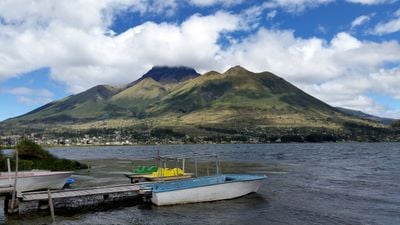
Imbabura Volcano, Stratovolcano in Imbabura Province, Ecuador.
Imbabura Volcano is an inactive stratovolcano in northern Ecuador rising to 4,640 metres. Its summit is a complex of cinder cones of varying heights, among them el Cubilche, Azaya (Huarmi Imbabura), Pangaladera, Cunrru, Artezón, Zapallo Loma, Angaraloma and Araque. The cone is exposed by erosion and easy to identify, and the peak is intermittently capped with snow but has no permanent glaciers.
Imbabura is a complex of cinder cones built by Strombolian eruptions during the late Pleistocene and early Holocene. The English source gives its last eruption as approximately 14,000 years ago, while the Spanish article records no thermal activity and calls it potentially active and in need of monitoring. Named cones include el Cubilche, Azaya (Huarmi Imbabura), Pangaladera, Cunrru, Artezón, Zapallo Loma, Angaraloma and Araque.
Locals personify the mountain as Taita Imbabura, "Papa" Imbabura, and consider it the sacred protector of the region. Legend makes him the husband of Mama Cotacachi, with peaks such as Yanahurca counted among their offspring. When it rains in Otavalo, people say Imbabura is "peeing" in the valley.
Hiking trails to the summit start from La Esperanza village and involve about 1,600 meters (5,250 feet) of elevation gain over varying terrain. Take time to acclimatize to the altitude as you climb, since the ascent is physically demanding.
The western slope features a natural formation that local artists frequently incorporate into their traditional work. This geographic detail has become a recognized motif in regional art and reflects how the mountain's physical features inspire creative expression.
The community of curious travelers
AroundUs brings together thousands of curated places, local tips, and hidden gems, enriched daily by 92,652 contributors worldwide.