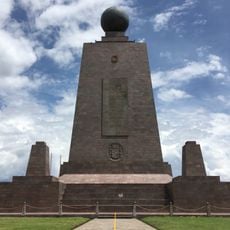
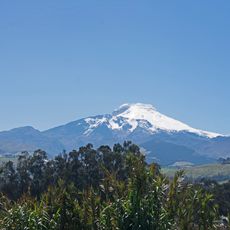
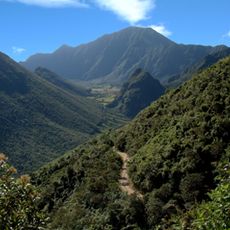
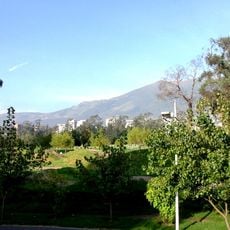
Quitsato Sundial, Solar timekeeper at La Mitad Del Mundo near Cayambe, Ecuador.
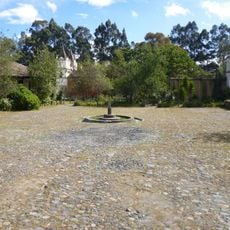
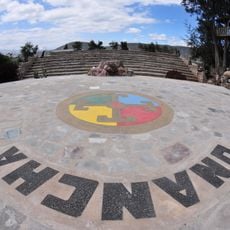
Quitsato Sundial is a circular platform 54 m in diameter, paved with light and dark pebbles forming an eight-pointed star that marks the solstices, equinoxes and cardinal directions. At its centre stands a 10 m orange cylindrical gnomon, 1.30 m in diameter, whose shadow indicates hours and months. The Equator line is traced in smaller dark pebbles between two metal plates.
Quitsato was built in 2006 and inaugurated in 2007 as an independent, non-profit project on a 2,300 m² plot near Cayambe, 47 km north of Quito. Its stated aim was to present the astronomical knowledge of the region's pre-Hispanic cultures and the history behind the concept of the "Middle of the World" and the name Ecuador. In 1736 the French Geodesic Mission spent a day at the equator on the old Guachalá hacienda and left a stone slab now kept at the Quito Astronomical Observatory.
The name Quitsato comes from the Tsáchila language and refers to the midpoint between two worlds. Community members, not outside staff, give the permanent expositions on pre-Hispanic astronomy and on how the concept of the "Mitad del Mundo" and the name Ecuador arose. Nearby, guides still perform equator tricks that lack scientific rigor.
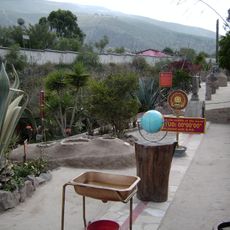
Visit on clear days when shadow movements are easiest to observe, particularly in late morning and afternoon hours. The site is flat and easy to walk around, with information boards explaining basic concepts at several spots along the circular layout.
During equinox times in spring and fall, the central pointer casts no shadow at all because the sun sits directly overhead. This rare event happens twice each year and graphically demonstrates the exact equatorial location.
The community of curious travelers
AroundUs brings together thousands of curated places, local tips, and hidden gems, enriched daily by 93,470 contributors worldwide.