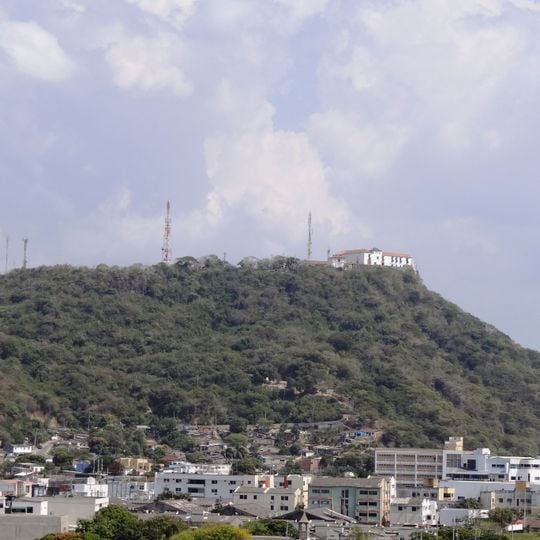
Cerro La Popa, Colonial hill with monastery in Cartagena, Colombia.
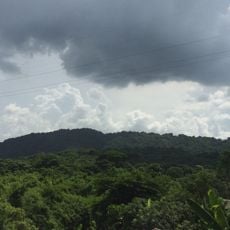
Cerro La Popa is the highest point in Cartagena de Indias, a hill rising 143 meters above the city, with dense dark green trees and scrub covering its slopes. At the crest stands a long white colonial monastery with a red-tiled roof and a row of arched openings, built between 1606 and 1611. Two tall lattice towers and two shorter poles stand to its left on the summit, and small structures and retaining walls are visible on the lower slope below the tree line.
Augustinian monks established the monastery in 1606 at the summit, making it a religious center for the Spanish colony. The hill also served as a lookout point to monitor the bay and watch for potential attackers.
The hill's name comes from the Spanish for a ship's stern, and its summit church holds a colonial painting of the black Virgin of Candelaria, patron of Cartagena. African slaves in the city were allowed to celebrate her feast until slavery was abolished. Pope John Paul II crowned the image canonically on 6 July 1986.
The hill is accessible to visitors during daylight hours and offers a well-marked path to the top. Comfortable shoes and water are recommended, as the path can be steep and slippery in places, especially during the rainy season.
Spanish explorers who first saw the hill in 1510 thought its summit looked like the stern (popa) of a large galley rising from the sea, so they called it Cerro de la Galera and the top La Popa. Old Cartagena residents also knew it as Cerro de la Cruz for the cross that crowns it.
The community of curious travelers
AroundUs brings together thousands of curated places, local tips, and hidden gems, enriched daily by 93,891 contributors worldwide.