Fuente de Petróleos, Oil industry monument at Reforma Avenue intersection, Mexico City, Mexico
Fuente de Petróleos is a monument at the intersection of Paseo de la Reforma and Anillo Periférico that honors Mexico's petroleum industry. It features sculptures and water elements representing oil production.
The monument was built in 1952 to commemorate Mexico's oil nationalization in 1938 under President Lázaro Cárdenas. This event marked a key moment in the country's economic independence.
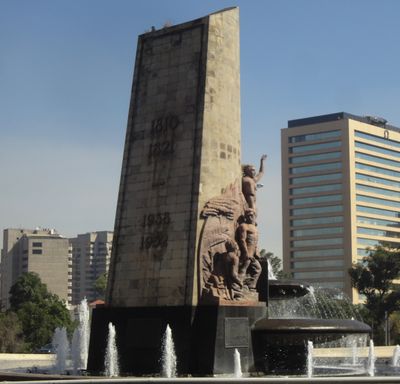
The south sculptural group shows a kneeling Indigenous man rescued by a worker holding a document inscribed "18 de marzo 1938". Beside them, a wingless nude Victoria pours water from her feet like oil, framed by oil drums and pipelines. The proud worker and the rescuer are self-portraits of Olaguíbel and Mendiola.
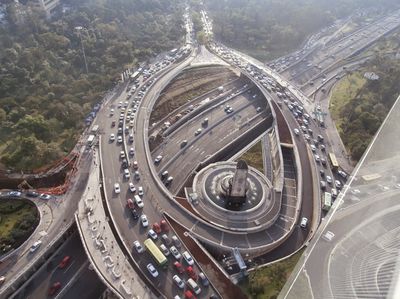
The monument stands in the centre of a 55-metre traffic circle at Paseo de la Reforma and Anillo Periférico; pedestrians reach it only by crossing the surrounding roadways, so use the marked crossings. The sculptures and the pillar face outward, and the best views are from the pavements around the junction. The gardens added in 2012 lie beside the circle.
The pillar's smooth front face carries the years 1810 and 1821 above 1938 and 1952, pairing the independence struggle with the oil expropriation and the monument's own inauguration. The two sculptors, Vicente Mendiola and Juan Fernando Olaguíbel, carved their own portraits into the bronze: the worker holding the law document is Mendiola, the proud standing figure is Olaguíbel.
The community of curious travelers
AroundUs brings together thousands of curated places, local tips, and hidden gems, enriched daily by 93,770 contributors worldwide.