Borda House, Colonial mansion in Historic Center, Mexico
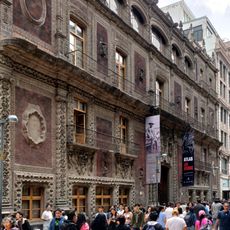
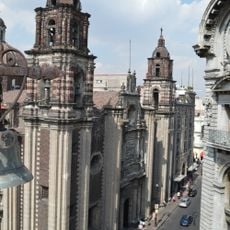
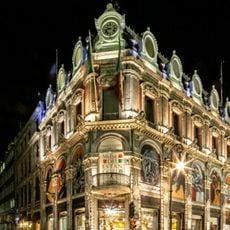
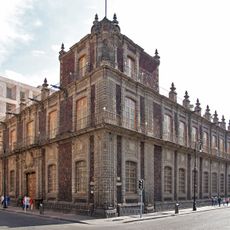
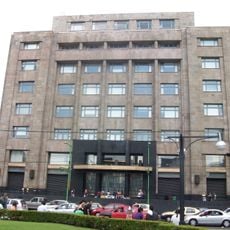
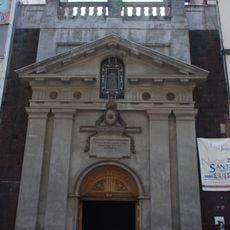
Borda House is a colonial mansion in the Historic Center of Mexico City, with a facade decorated with carved stonework and wrought iron balconies. The building spans several street addresses and is divided into sections, most of which now operate as shops and commercial spaces.
José de la Borda, one of the richest men in 18th-century New Spain, had this mansion built as a gift for his wife Teresa Verdugo y Aragonés, intending it to rival the house of Hernán Cortés and his descendants. The architect Francisco Antonio Guerrero y Torres covered an entire city block, bounded by today's Madero, Bolívar, 16 de Septiembre and Motolinía streets, with three floors of red tezontle and grey-white sandstone. Over the centuries the house was divided and mostly demolished; five plots remain, four retaining the original double balcony.
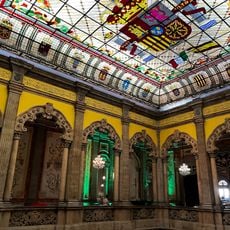
The house was built as a gift for José de la Borda's wife, Teresa Verdugo y Aragonés, and was meant to rival the palace of Hernán Cortés and his descendants. Near the main entrance stood a large niche with a statue of the Virgin of Guadalupe. The interior was richly decorated with carpets, heavy curtains, paintings, porcelain, clocks, sculptures and carved furniture.
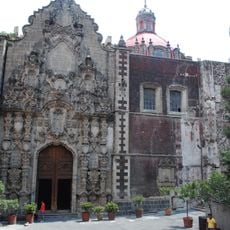
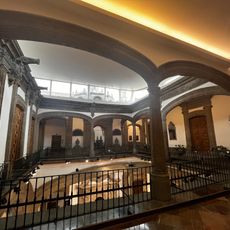
The house occupies five plots at 27, 29 and 33 Madero Street and 26-28 Bolívar Street, near the old San Francisco monastery and the Palace of Iturbide. Only number 26 Bolívar keeps its full 18th-century interior; the other plots retain just façades, so look for the double balcony and the Neptune tile panel in the stable courtyard.
The section at number 33 on the street once housed the Salón Rojo, one of the city's first movie theaters, which had an electric escalator in the early 1900s. That kind of mechanical feature was extremely rare in Mexico City at the time.
The community of curious travelers
AroundUs brings together thousands of curated places, local tips, and hidden gems, enriched daily by 93,819 contributors worldwide.