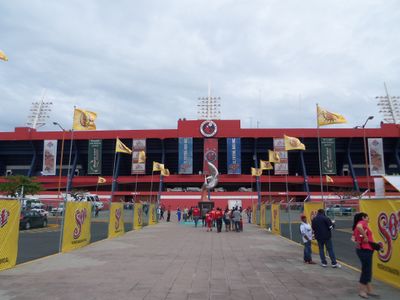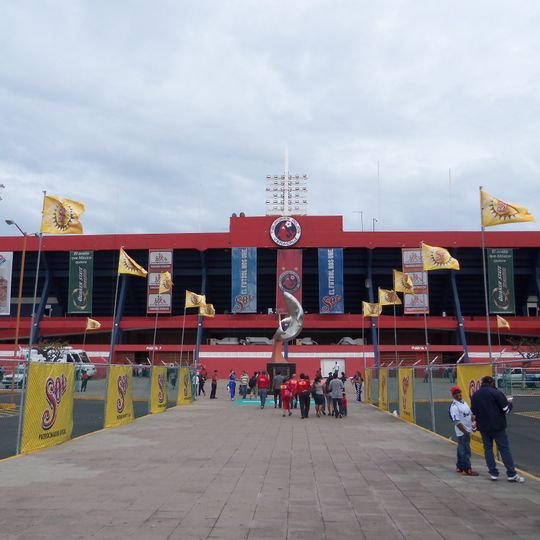
Estadio Luis "Pirata" Fuente, football (soccer) stadium in Veracruz, Veracruz, Mexico, home venue for Tiburones Rojos de Veracruz
Estadio Luis "Pirata" Fuente is an association football venue in Veracruz, Mexico, with steep stands arranged closely around the playing field. The structure was fully rebuilt between 2022 and 2025 and now has gray seating, updated lighting rigs, and reworked entry points around the perimeter.
The stadium opened on 17 March 1967 as Estadio Veracruzano and was later renamed in honour of Luis de la Fuente, the Veracruz forward known as El Pirata who played for C.D. Veracruz from 1943 to 1952. It was the intermittent home of the Tiburones Rojos until the club's dissolution on 18 December 2019. Demolition began in December 2022 and the rebuilt venue reopened in 2025, hosting Piratas F.C. from 2026.
The stadium is named after Luis de la Fuente, a forward who played for C.D. Veracruz from 1943 to 1952 and is regarded as the greatest footballer from Veracruz. Fans know him as El Pirata, and the ground is nicknamed El Coloso del Fraccionamiento Virginia. The name Estadio Veracruzano was dropped in his honour.
The stadium stands by the seaside in Boca del Río, within the Veracruz metropolitan area, not in Veracruz city proper. It is reached by road from the city and port of Veracruz. After the 2022–2025 reconstruction the venue reopened with a capacity of 27,500, and in the 2025–26 season it hosted concerts and mass events rather than regular league football.
The stadium's nickname, "Coloso del Fraccionamiento Virginia", comes from the Veracruz neighbourhood where it stands. Its opening ceremony on 17 March 1967 was held under the name Estadio Veracruzano, and the tribute to Luis de la Fuente came later. In November 2014 it hosted the opening ceremony of the XXII Central American and Caribbean Games, with a pyramid modelled on El Tajín built on the pitch.
The community of curious travelers
AroundUs brings together thousands of curated places, local tips, and hidden gems, enriched daily by 94,448 contributors worldwide.