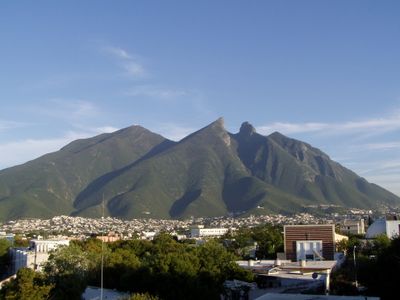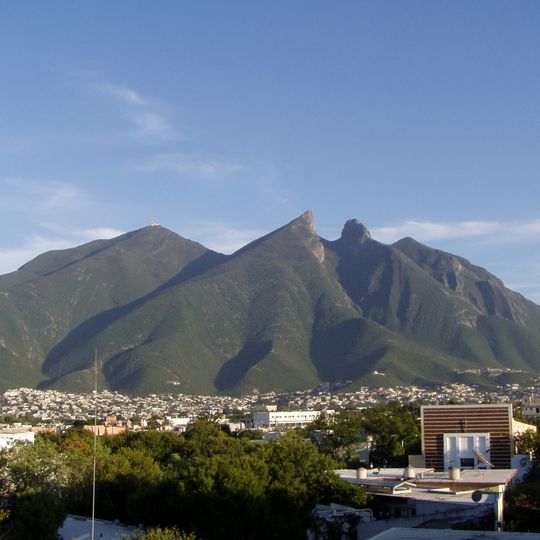
Cerro de la Silla, Natural monument summit in Monterrey, Mexico.
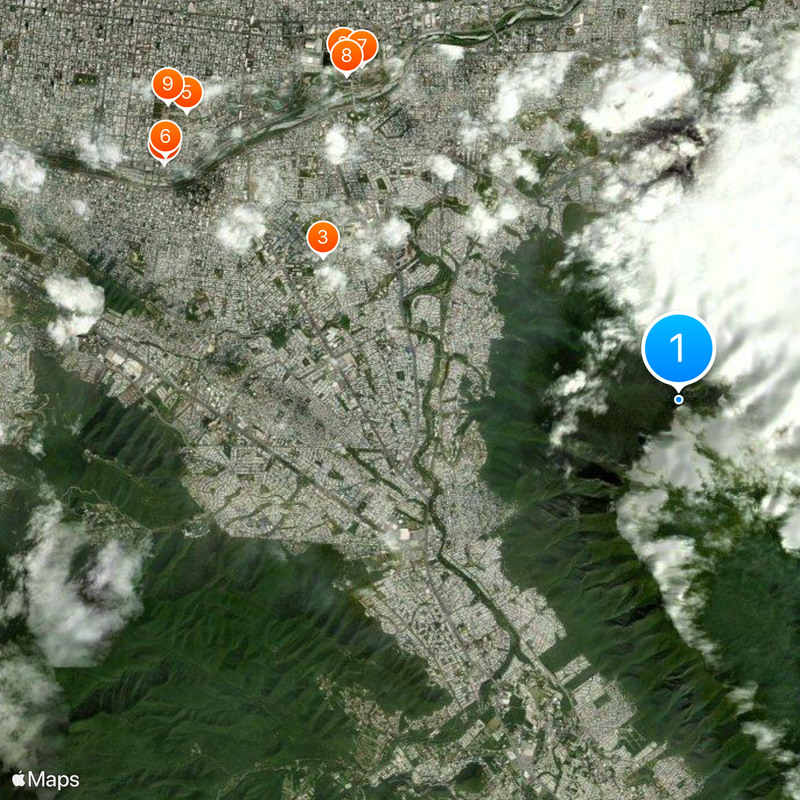
Cerro de la Silla is a mountain of folded Cretaceous limestone and shale in the Sierra Madre Oriental foothills, spanning about 60.5 km² across Guadalupe, Monterrey and Juárez in Nuevo León. Its four peaks are Pico Antena, Pico Norte (1,821 m, the highest), Pico Sur and Pico la Virgen (about 1,750 m, the lowest). Slopes run from near flat ground at the Cañón de la Boca, around 450 m, to over 124%.
The Cerro de la Silla was declared a Natural Monument by presidential decree published in the Diario Oficial de la Federación on 26 April 1991, the first protected natural area in Mexico to receive that category, on grounds of its aesthetic, historical and scientific value. In the second half of the 20th century an aerial tramway was built on the north side; it opened and closed on 2 June 1961, when an accident killed five people, among them its designer, the engineer Jesús Fernández.
The name "Silla" refers to the saddle profile the mountain shows from Monterrey. It is an icon of the city and one of the main symbols of Nuevo León, and the cerro is a common recreational area for hikers. The mountain covers parts of Guadalupe (31.62%), Monterrey (13.23%) and Juárez (55.15%).
The main trail to the summit runs 5.3 km (3.3 mi) and takes about three hours with proper gear and water. Start early in the morning to avoid midday heat and bring sun protection.
An abandoned cable car station still stands on the north side, where a system operated for only one day in 1961. The structure was never reopened after that and slowly weathers in the mountain climate.
The community of curious travelers
AroundUs brings together thousands of curated places, local tips, and hidden gems, enriched daily by 92,894 contributors worldwide.