Aggie Doppler Radar, Weather radar at Texas A&M University, College Station, US
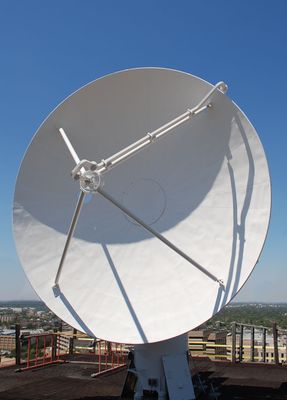
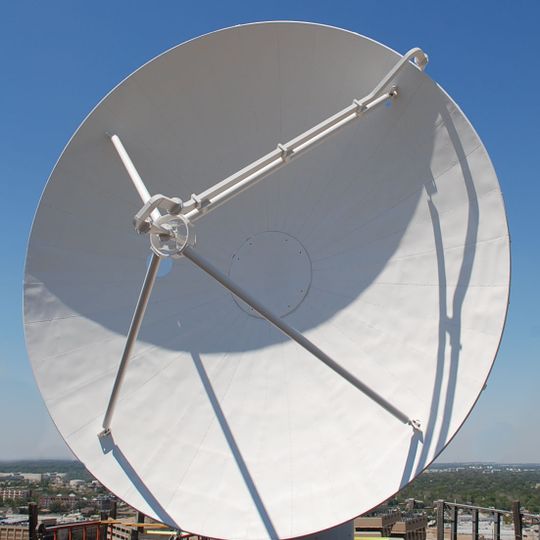
Aggie Doppler Radar was a pulsed Doppler weather radar mounted on the roof of the Eller Oceanography & Meteorology Building at Texas A&M University in College Station. Its parabolic solid antenna measured 4.88 metres in diameter and sat 172.5 metres above mean sea level. The transmitter, an Enterprise Electronics DWSR-88S, operated at 10.56 cm wavelength (2840 MHz, S band) with a peak power of 1 megawatt.
The meteorology department began studying convective storms in the early 1950s with an AN/CPS-9 radar from the US Air Force, the first purpose-built weather radar. On 5 April 1956 its modified APS-2F detected hook-shaped echoes and a V-notch; at 14:45 meteorologists warned Bryan police of a tornado 30 minutes before damage began at 15:09, likely the first warning based solely on radar data. A 10-cm WSR/TAMU-1 followed in 1962, dual wavelength in 1966, and rooftop installation on the Eller O&M Building in 1973. Doppler capability arrived in 1992 via a Lassen Research PSP-32 processor, creating ADRAD; the pedestal was upgraded and side dishes removed in 1997. ADRAD was taken down in June 2024 and replaced by a Climavision Ranger X5.
The radar's name gave the department its nickname: the Aggie Doppler RADar was shortened to ADRAD in 1992, when a Lassen Research PSP-32 processor added Doppler capability. From October 1998, live radar images were posted online during storms, and in 2016 ADRAD data reached National Weather Service offices through Gibson Ridge Analyst software.
The radar sits atop the Eller Oceanography & Meteorology Building on the Texas A&M campus in College Station, about 172.5 m above sea level. It is an operating research installation, not a visitor attraction, so the roof and equipment are not open to the public. The original ADRAD was removed in late June 2024 and replaced by a Climavision Ranger X5 with a 2.4 m antenna inside a 3.7 m radome.
The original radar system served for approximately 50 years before being replaced in 2024 with a modern dual-polarization instrument. This upgrade allows for sharper storm detection and improved forecasting capabilities that benefit the entire region.
The community of curious travelers
AroundUs brings together thousands of curated places, local tips, and hidden gems, enriched daily by 93,030 contributors worldwide.