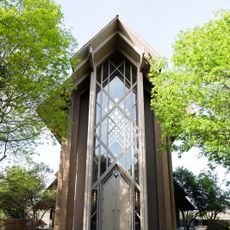
Fort Worth Japanese Garden, Japanese garden in Fort Worth, Texas
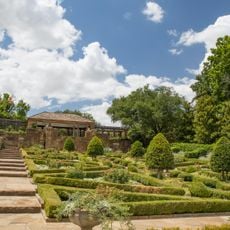
Fort Worth Japanese Garden is a 7.5-acre stroll garden in a former gravel pit, built around three ponds fed by waterfalls and ringed by hills. Paths link bridges, decks, a pavilion modelled on a Shinto hall, and a pagoda. The garden combines hill-and-pond, dry-landscape, tea-garden and enclosed-garden styles.
The garden occupies a former gravel pit and dump in a valley opening onto the Clear Fork of the Trinity River. Kingsley K. Wu, a University of Tokyo graduate teaching at Texas Women's University, was hired in 1968 to finalize the design, and the garden was dedicated in 1973. Nagaoka, Fort Worth's Japanese sister city, donated plants and building materials; its main gate, by Albert Komatsu and Associates, was dedicated in 1976. Nagaoka sent a mikoshi in the 1990s, and landscape architect Shigeichi Suzuki donated plans for a karesansui addition in 1997, completed in 2000 as the Suzuki Garden.
The garden displays Japanese design principles that visitors experience across its different sections, from carefully shaped hills overlooking water to quiet tea garden areas. Each section reflects how Japanese culture sees the relationship between people, plants, and water.
The garden sits in a sunken valley reached by a network of interconnected paths, bridges, pavilions and decks, so allow time to walk the full loop. Surfaces include gravel, stone and steps, and the ground rises and falls around the ponds and hills. The Moon-Viewing Deck is climbed by steps to a flat top.
One section features fifteen stones arranged in fine gravel to replicate a famous Kyoto garden design. The arrangement shows dry garden techniques that attract visitors interested in how Japanese designers create meaning from minimal elements.
The community of curious travelers
AroundUs brings together thousands of curated places, local tips, and hidden gems, enriched daily by 93,254 contributors worldwide.