Sabine Bank Light, Maritime lighthouse in Jefferson County, United States
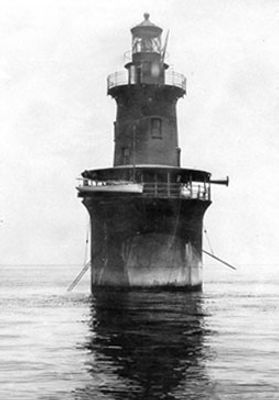
Sabine Bank Light is a lighthouse constructed from iron and caisson materials, standing in the Gulf of Mexico south of the Sabine River mouth. The structure marks a dangerous shallow area that posed risks to passing vessels.
In 1888 Rep. William H. Crain asked for a lightship to mark the shoal, but district engineers dismissed the request. Around the turn of the century $40,000 was appropriated for a fixed light, and construction of the caisson began in June 1904. Halted by lack of funds and then by an October storm, it was finished in spring 1906 and first lit on March 15, 1906.
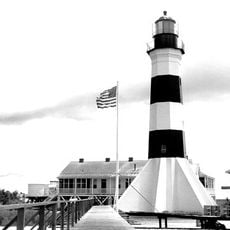
The station's third-order Fresnel lens, which guided ships until 1971, is now displayed at the Museum of the Gulf Coast in Port Arthur. The tower's lantern was saved when the original structure was removed in 2002 and stands in a park in Sabine Pass. Fishermen and outdoorsmen know the light as "The Eighteen Mile Light", for its distance from the old Coast Guard Lifeboat Station.
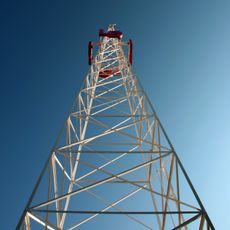
The station stands in open water on the old caisson foundation, so it can only be seen from a boat; there is no landing or dock. The present skeleton tower shows an isophase red light: three seconds lit, three seconds dark, every six seconds, at a focal height of 22 metres. The original lantern is kept in a park at Sabine Pass, and the Fresnel lens is in the Museum of the Gulf Coast in Port Arthur.
The nickname "The Eighteen Mile Light" refers to the tower's distance from the old Coast Guard Lifeboat Station. The original lantern was saved when the tower was removed in 2002 and now stands in a park in Sabine Pass, while the third-order Fresnel lens is displayed at the Museum of the Gulf Coast in Port Arthur.
The community of curious travelers
AroundUs brings together thousands of curated places, local tips, and hidden gems, enriched daily by 93,957 contributors worldwide.