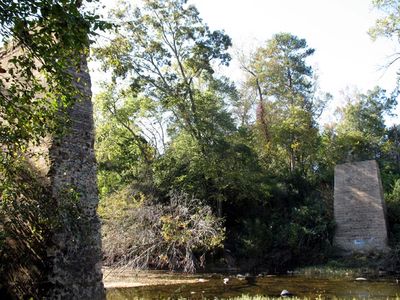
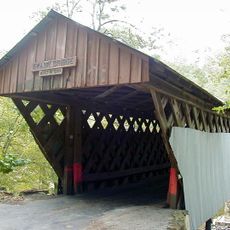
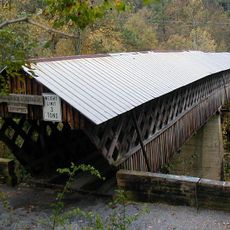
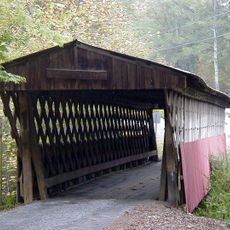
Nectar Covered Bridge, Covered bridge ruins in Nectar, Alabama, United States.
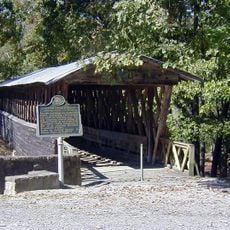
Nectar Covered Bridge was a wood-and-metal covered bridge over the Locust Fork of the Black Warrior River, built as a Town lattice truss across four spans. It measured 385 feet (117 m) and carried single-lane motor traffic on Nectar Bridge Road off State Route 160, about 14 miles northwest of Oneonta.
Built in 1934 by a crew led by foreman Zelma C. Tidwell, the 385-foot Town Lattice truss bridge carried single-lane traffic over the Locust Fork. It was listed on the National Register of Historic Places on August 20, 1981. Vandals burned the structure on June 13, 1993, and only the old stone piers remain south of the current concrete crossing.
The bridge served as a gathering place where the community came together for local celebrations and everyday interactions. This crossing held social importance as a vital link connecting the settlements on both sides of the river.
The stone piers stand in the Locust Fork south of the concrete bridge that now carries Nectar Bridge Road off State Route 160, about 14 miles northwest of Oneonta. They are best seen from the modern crossing or the riverbank; footing along the water is uneven, so watch your step near the piers.
The bridge was once a community meeting place and hosted large baptism ceremonies in the Locust Fork. Its 385-foot Town Lattice truss made it the seventh-longest covered bridge in the country at one time.
The community of curious travelers
AroundUs brings together thousands of curated places, local tips, and hidden gems, enriched daily by 93,031 contributors worldwide.