Plaza de la Revolución, main city square in Havana, Cuba
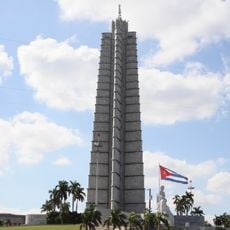
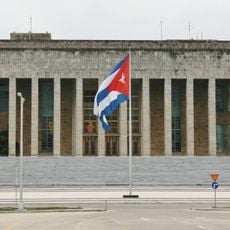
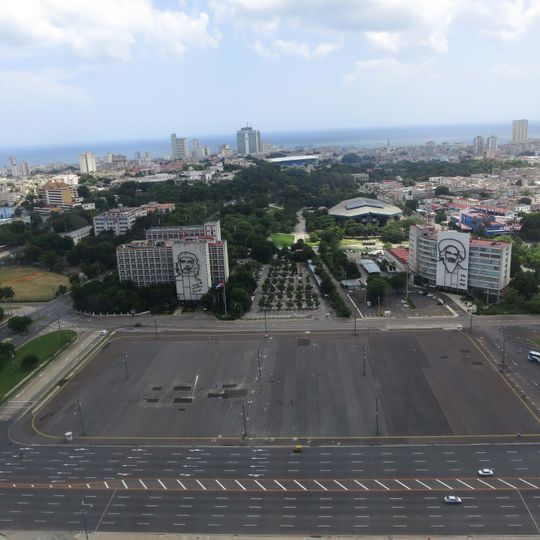
Plaza de la Revolución is a 72,000 m² paved public square in Havana's Plaza de la Revolución municipality, laid out at the crossing of Paseo and Rancho Boyeros avenues. Its flat dark-gray surface holds recessed rectangular sections and small square features. Facing the open space stand the Ministry of the Interior, whose facade carries a relief of Ernesto "Che" Guevara based on Alberto Korda's photograph and made by Enrique Ávila, and the Ministry of Communications with its Camilo Cienfuegos sculpture. In the northeast corner rises the José Martí Monument, a 112.75 m tower with a marble statue of Martí ringed by six pillars for the former provinces.
The idea of the square dates to the early 1940s, when an international competition was held for a monument to José Martí on the site of the former La Ermita de los Catalanes chapel; the decision was taken in 1943. Built under Fulgencio Batista as the Plaza Cívica, it was nearly finished in 1959 and renamed Plaza de la Revolución José Martí on 16 July 1961.
The square was renamed Plaza de la Revolución José Martí on 16 July 1961. Its facades carry the faces of Ernesto "Che" Guevara, a relief based on Alberto Korda's photograph and made by Enrique Ávila, and of Camilo Cienfuegos, whose sculpture at the Ministry of Communications was installed in 2009. Fidel Castro gave mass speeches here.
The square is flat and easy to cross, but offers little shade, so bring water and sun protection, especially on hot days. Early morning or late afternoon visits are best, when the sun is less intense.
The José Martí Monument at the square's northeast end reaches 112.75 m to the top of its tower and 141.99 m to its flags and lights, making it the highest point in Havana. Its marble statue of Martí is encircled by six pillars standing for Cuba's former provinces.
The community of curious travelers
AroundUs brings together thousands of curated places, local tips, and hidden gems, enriched daily by 92,865 contributors worldwide.