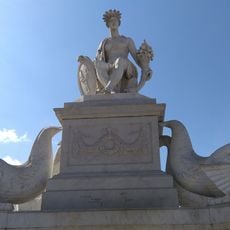
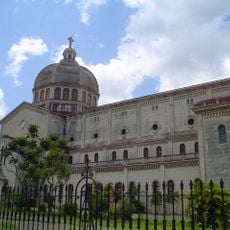
Acueducto de Albear, Colonial water supply system in Havana, Cuba
The Albear Aqueduct is a gravity-fed water system that carries water from the Vento springs, 12 km south of Havana, through a covered canal with an oval cross-section 2.40 m deep and up to 1.98 m wide. Its slope of 1:5000 delivers 1.67 m³/s (144,000 m³/day), and the system includes a tunnel under the Almendares River, storage tanks and a distribution network.
The project was approved by royal decree in 1858, but construction only began in 1861 under Francisco de Albear, delayed by scarce funds and the Ten Years' War. The Vento canal and the Fernando VII filters were linked in 1878, after the Peace of Zanjón. Albear died of malaria in 1887 without seeing the work finished; Joaquín Ruiz and E. Sherman Gould carried it on, and the system opened on 22 January 1893, 32 years after work started.
The structure carries the name of its creator Francisco de Albear, reflecting his lasting impact on Cuban engineering and infrastructure. Walking through Havana, visitors can spot sections of this historic system that shaped how the city developed and grew.
The system is visible at various points throughout Havana, especially where reservoirs and open canals are easy to spot. The best time to visit is during daylight hours when you can clearly see the structure and how different sections fit together.
The canal's oval cross-section is 2.40 m deep and up to 1.98 m wide; with a slope of 1:5000 it carries 1.67 m³/s, about 144,000 m³ a day, and up to 302,800 m³ at high water. Albear's design assumed 500 litres per inhabitant per day, the standard of his era.
The community of curious travelers
AroundUs brings together thousands of curated places, local tips, and hidden gems, enriched daily by 92,865 contributors worldwide.