Molonglo Observatory Synthesis Telescope, Radio telescope in Hoskinstown, New South Wales, Australia
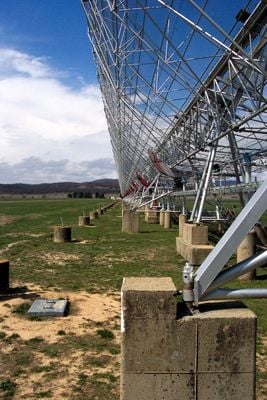
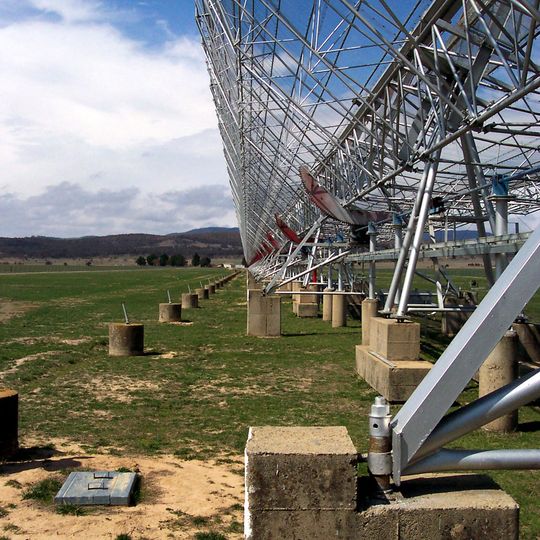
The Molonglo Observatory Synthesis Telescope (MOST) is a radio telescope in Hoskinstown, New South Wales, Australia, operating at 843 MHz. It consists of two cylindrical paraboloids, each 778 m long and 12 m wide, separated by 15 m and aligned east–west. A line feed of 7744 circular dipoles collects signals, feeding 176 preamplifiers and 88 IF amplifiers. The telescope is steered by rotating the paraboloids about their long axis and by phasing the feed elements.
The original design of the telescope dates to 1960, led by Professor Bernard Y. Mills, and the instrument became operational in 1967. Over the following decades, the facility was upgraded several times, including the addition of a digital signal processing system that opened new areas of research.
The observatory takes its name from the Molonglo River, which runs close to the site. Researchers from several universities use it regularly to study the southern sky, making it a working hub for radio astronomy in Australia.
The site sits in a remote, flat area chosen to keep outside radio interference as low as possible, so reaching it requires some planning. As it is an active research facility, visitor access may be limited to specific areas, and it is worth checking in advance before making the trip.
The telescope was among the first to pinpoint the precise location of fast radio bursts, a type of cosmic signal whose origin is still not fully understood. This made it a key tool for a field of research that did not even exist when the instrument was first built.
The community of curious travelers
AroundUs brings together thousands of curated places, local tips, and hidden gems, enriched daily by 94,072 contributors worldwide.