Flat Bridge, Timber beam bridge in Bog Walk, Jamaica
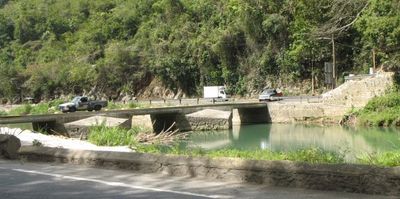
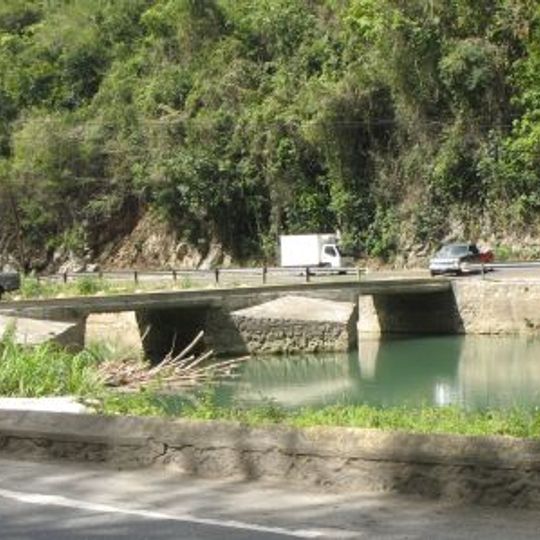
Flat Bridge is a timber beam bridge over the Rio Cobre on the A1 road north of Spanish Town, one of Jamaica's oldest bridges. It has three spans carried by two piers and two abutments, with a deck of planks on a timber frame; stone hemispheres are now its only protection. Traffic crosses in a single lane controlled by lights.
Flat Bridge was built after 1724; Edward Long described its timber deck on a braced frame in his 1774 History of Jamaica. The sixteen Bog Walk plantations sent one enslaved worker in fifty to build the River Road, and labourers dug gravel, marl, lime, sand and stone in the gorge, where many died. Timber and mason contracts were authorised at vestry meetings. Between 1881 and 1915 the floor was washed away and re-laid with iron girders and buckle plates from the old May Pen bridge flooring.
The bridge carries the A1 road as a single lane, so traffic is managed by traffic lights. It is often flooded after heavy rains, and motorists are then advised to take alternative routes through Barry and Sligoville. Edward Long described it in his History of Jamaica, printed in 1774, as flat and composed of planks on a frame of timberwork.
Flat Bridge carries a single lane of the busy A1 road, so crossing is controlled by traffic lights. The bridge floods after heavy rains; in those conditions motorists are advised to use alternative routes through Barry and Sligoville. Stone hemispheres are the only protection on the bridge itself.
The bridge's only remaining protection is a set of stone hemispheres; metal handrails from the 1930s and later wooden ones were each swept away by the Rio Cobre. The crossing floods after heavy rain, and drivers are then directed to alternative routes through Barry and Sligoville.
The community of curious travelers
AroundUs brings together thousands of curated places, local tips, and hidden gems, enriched daily by 93,831 contributors worldwide.